Why Kibble Size Matters for a French Bulldog Puppy's Dry Food
General nutrition information compiled from product labels and published sources, not veterinary advice. Your veterinarian is the right person to choose a diet for your dog, especially one with a health condition.
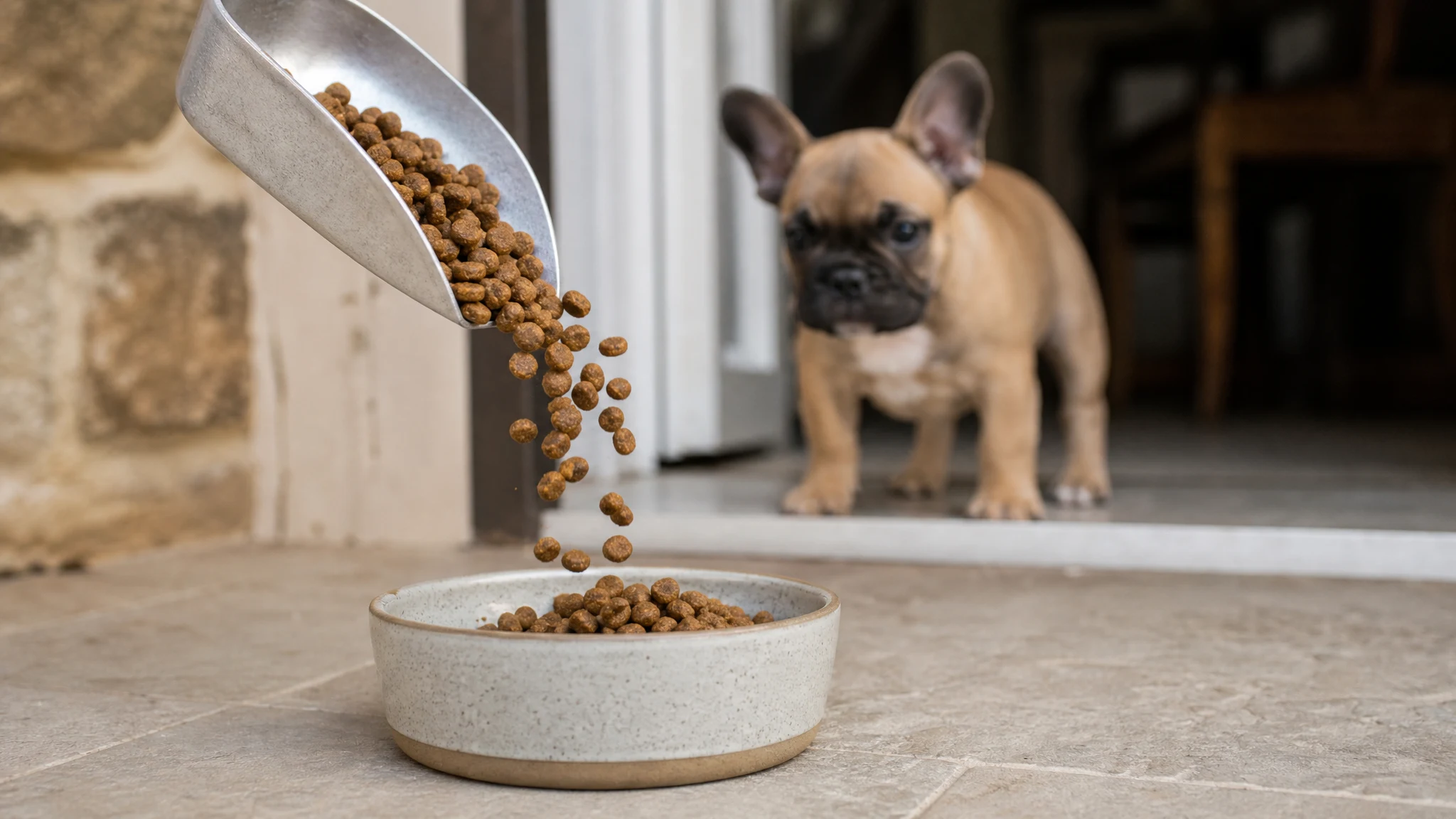
Most advice on the best dry food for French Bulldog puppy households starts with protein percentages and ingredient lists. Those matter. But there is a quieter question that gets less attention: what does the kibble physically look like, and can a flat-faced puppy pick it up and chew it comfortably?
This guide walks you through how to judge kibble size and shape for a French Bulldog puppy, using only what brands publish on their own pages. It also shows where that information runs out, because for several foods it does.
Why the breed's face makes kibble shape worth a look
French Bulldogs are brachycephalic, which means flat-faced with a short muzzle. The Royal Canin US breed library says the breed is prone to respiratory problems from this build. It also links brachycephalic airway obstruction to gastrointestinal signs, and many affected dogs show them.
That does not mean kibble shape fixes or prevents anything. It means mealtime is one place where the breed's anatomy meets a product design choice. Royal Canin describes its French Bulldog puppy kibble as "customized curved-shaped kibble" that is "specially designed for your French Bulldog's short muzzle and underbite." That is the brand's own design claim. We have not fed it or watched puppies eat it, so treat it as a manufacturer statement, not a verified result.
The practical takeaway is simple. A puppy with a short muzzle may handle some kibble shapes more easily than others, and you can watch for that at home. A veterinarian is the right person to ask if your puppy struggles to eat.
What this guide is, and how the comparison was done
We compared label and product-page data. We did not run feeding trials or taste tests, and we did not test any food with puppies. Where a brand does not publish a kibble size, we say so instead of guessing.
That gap is the first important finding. Of the dry puppy foods we looked at, none gave a numeric kibble diameter. Brands describe shape or use phrases like "appropriate kibble size." If you want exact dimensions, contact the brand directly.
Materials you will need
- The bag or product page for each food you are considering, so you can read the real label.
- A kitchen scale or a standard measuring cup, to follow a feeding guide as a starting point.
- A notebook or phone notes to record how your puppy eats each food.
- Your puppy's current weight and age. Our French Bulldog puppy growth chart by month can help you see where a puppy sits along the usual curve.
- Your veterinarian's contact details, for questions about eating trouble, weight or stool changes.
Step 1: Confirm the food is a growth formula that fits the breed
Start with the nutritional adequacy statement. It should say the food meets AAFCO nutrient profiles for growth, or for all life stages. Many puppy owners worry about the "large-size dogs" wording on these statements, so here is what it means.
According to Whole Dog Journal, since 2016 AAFCO has required growth and all-life-stages labels to say either "including growth of large-size dogs (70 pounds or more as an adult)" or "except for growth of large-size dogs." The French Bull Dog Club of America breed standard says a French Bulldog should not exceed 28 pounds. So the "except for large-size dogs" wording is not a problem for this breed. A French Bulldog puppy does not need a large-breed growth formula.
Examples from brand pages:
- Royal Canin's French Bulldog Puppy says it is formulated for growth "including growth of large size dogs (70 lb. or more as an adult)."
- Victor Hi-Pro Plus Small & Medium Breed Puppy says it is formulated for all life stages "except for growth of large size dogs (70 lb. or more as an adult)."
Either wording is workable for a dog that will stay under 28 pounds. Check the statement on the exact bag you buy.
Step 2: Look for what the brand says about kibble size or shape
Now read the product page for any mention of size or shape. Here is what the brands publish for the dry foods we reviewed on paper:
| Food | What the brand page says about kibble |
|---|---|
| Royal Canin Breed Health Nutrition French Bulldog Puppy | Curved shape designed for a short muzzle and underbite. No numeric size stated. |
| Victor Hi-Pro Plus Small & Medium Breed Puppy | "Appropriate kibble size" for small and medium breeds. No numeric size stated. |
| Victor Hi-Pro Plus | No kibble size stated. |
| Hill's Science Diet Puppy Small & Mini Chicken & Brown Rice | No kibble size stated. |
| Hill's Science Diet Puppy Chicken & Brown Rice | No kibble size stated. |
| Hill's Science Diet Puppy Sensitive Stomach & Skin Salmon & Brown Rice | No kibble size stated. |
If a page is silent, that does not mean the kibble is a poor fit. It means you cannot judge it from the label. In that case, ask the brand through its own website, or buy the smallest bag available and watch how your puppy handles it.
You can read the product details on the brand pages themselves: Royal Canin French Bulldog Puppy, Victor Hi-Pro Plus Small & Medium Breed Puppy and Hill's Science Diet Puppy Chicken & Brown Rice.
Step 3: Compare calories per cup, because piece size affects portions
Kibble size and calorie density work together. A small, dense kibble packs more energy into each cup. This matters for a breed that, according to Royal Canin, gains weight easily. (The UK VetCompass research points the other way in some analyses, so a veterinarian's body-condition check is more useful than any single claim.)
Calories per cup as published by the brands:
- Royal Canin French Bulldog Puppy: 373 kcal ME per cup, as fed (calculated).
- Victor Hi-Pro Plus Small & Medium Breed Puppy: 383 kcal per cup.
- Victor Hi-Pro Plus: 406 kcal per cup.
- Hill's Science Diet Puppy Chicken & Brown Rice: 390 kcal per cup.
- Hill's Science Diet Puppy Sensitive Stomach & Skin Salmon & Brown Rice: 405 kcal per cup.
- Hill's Science Diet Puppy Small & Mini Chicken & Brown Rice: 418 kcal per cup.
The spread here is about 45 kcal per cup. If you switch between foods, do not assume a cup of one equals a cup of another. Recheck the feeding guide each time.
Step 4: Use the feeding guide as a starting point
Feeding guides are starting points, not prescriptions. Royal Canin's French Bulldog Puppy page has a daily table by puppy age (2 to 9 months) and expected adult weight (18, 22 and 31 lb). For example, for a 3-month-old with an 18 lb adult target, it lists 1 1/2 cups (144 g) per day.
Hill's pages say to adjust amounts as needed to maintain an optimal weight, and to ask your veterinarian if you are unsure. Victor's Hi-Pro Plus page suggests feeding as much as the puppy will eat in 20 minutes across four feedings, which is a different approach from a fixed daily amount. With a breed that gains weight easily, ask your veterinarian which approach suits your puppy.
Royal Canin's life-stage table treats a French Bulldog as a puppy from 2 to 12 months. Adult males are listed at 20 to 28 lb and females at 17 to 24 lb. These are the ranges to keep in mind when you pick a target adult weight on a feeding chart.
Step 5: Watch your puppy eat and write down what you see
This is where kibble size becomes real. For the first week or two with any new food, note the following at each meal:
- Does the puppy pick up the pieces easily, or push them around the bowl?
- Does the puppy chew, or swallow pieces whole?
- Is there gagging, coughing or choking, or noisy breathing during meals?
- Does the puppy finish at a steady pace, or stop and start?
- What do stools look like over the following days?
Coughing, gagging or repeated vomiting around meals are reasons to call your veterinarian, not to switch foods on your own. Because the breed is prone to airway problems, as the Royal Canin breed library notes, these signs are worth professional attention.
Step 6: Change foods gradually and only for a reason
If you decide a different kibble suits your puppy better, do not swap overnight. A gradual changeover, mixing the new food with the old over several days, is the usual approach. Ask your veterinarian for a schedule that suits your puppy, especially if there has been any digestive upset.
Avoid switching just because a bag claims a better shape. Judge a food by the whole label: the nutritional adequacy statement, the ingredient list, calories and how your puppy actually does on it.
Tips for choosing
- Read ingredients with a skeptical eye. The first five ingredients tell you something, but not everything. For example, Royal Canin's French Bulldog Puppy lists brewers rice, chicken by-product meal, wheat, chicken fat and chicken meal first. Victor Hi-Pro Plus Small & Medium lists beef, chicken, beef meal, chicken meal and whole grain sorghum. These are different recipes, and neither list says anything about kibble size.
- Do not rely on "small breed" labels alone. A small-breed puppy food is aimed at small dogs in general. A French Bulldog is sturdy, with a short muzzle, and the label may not say what that means for the kibble.
- Do not borrow another breed's formula without checking. Royal Canin also makes a Miniature Schnauzer puppy food with its own jaw-shaped kibble. That shape is designed for a different face.
- Mind the treats and toppers. Extra calories add up quickly in a small dog.
- Weigh your puppy regularly. Compare against the growth chart and share the numbers at vet visits.
Common mistakes to avoid
- Assuming a breed-named food is automatically right. It is a reasonable place to start, but your puppy's own eating, stools and body condition matter more than the front of the bag.
- Guessing at kibble size. If the brand does not publish it, ask. Do not assume.
- Using cups from an old bag. Calories per cup differ by food, so recalculate when you change.
- Treating a food as a medical fix. No kibble prevents, treats or cures skin trouble, airway problems or digestive issues. Only a veterinarian can decide what diet fits an individual dog. Prescription diets are something a veterinarian prescribes, not something to pick from a shelf.
- Chasing grain-free by default. The FDA's investigation into a potential link between certain diets and canine dilated cardiomyopathy has a latest update dated 12/23/2022, and the agency said it would not publish further public updates until there is meaningful new scientific information. That is no reason to panic. It is a reason to talk with your veterinarian about the diet you choose.
What to expect
A kibble that suits your puppy's mouth may make mealtimes easier, and you may notice your puppy eating at a steadier pace. A well-chosen growth formula fed at a sensible amount may help support steady growth, though results vary from dog to dog and depend on much more than kibble size.
You might also find that your puppy is simply indifferent to shape. That is fine. Calories, nutritional adequacy and body condition remain the main measures of a good fit. If you see ongoing trouble eating, weight that climbs faster than expected, skin irritation or digestive upset, bring your notes to your veterinarian.
A simple summary for choosing the best dry food for a French Bulldog puppy
The best dry food for French Bulldog puppy owners to consider is the one that meets AAFCO growth requirements, suits the label data you can verify, and is eaten comfortably by your own dog. Kibble shape is one piece of that picture. Only Royal Canin publishes a breed-specific shape for this breed among the foods reviewed here, and it publishes no numeric size.
When a brand is silent about size, the honest answer is to ask the brand, watch your puppy, and lean on your veterinarian.
Sources
- French Bull Dog Club of America, French Bulldog Breed Standard
- Royal Canin US breed library, French Bulldog
- Royal Canin US, Breed Health Nutrition French Bulldog Puppy Dry Dog Food
- Victor Pet Food, Hi-Pro Plus Small & Medium Breed Puppy
- Victor Pet Food, Hi-Pro Plus
- Hill's Pet, Science Diet Puppy Chicken & Brown Rice Recipe
- Hill's Pet, Science Diet Puppy Small & Mini Chicken & Brown Rice Recipe
- Hill's Pet, Science Diet Puppy Sensitive Stomach & Skin Salmon & Brown Rice Recipe
- Whole Dog Journal, In the Fine Print: Nutritional Adequacy Statements
- FDA Center for Veterinary Medicine, investigation into a potential link between certain diets and canine dilated cardiomyopathy