Food for a French Bulldog Puppy: What Changes as They Grow
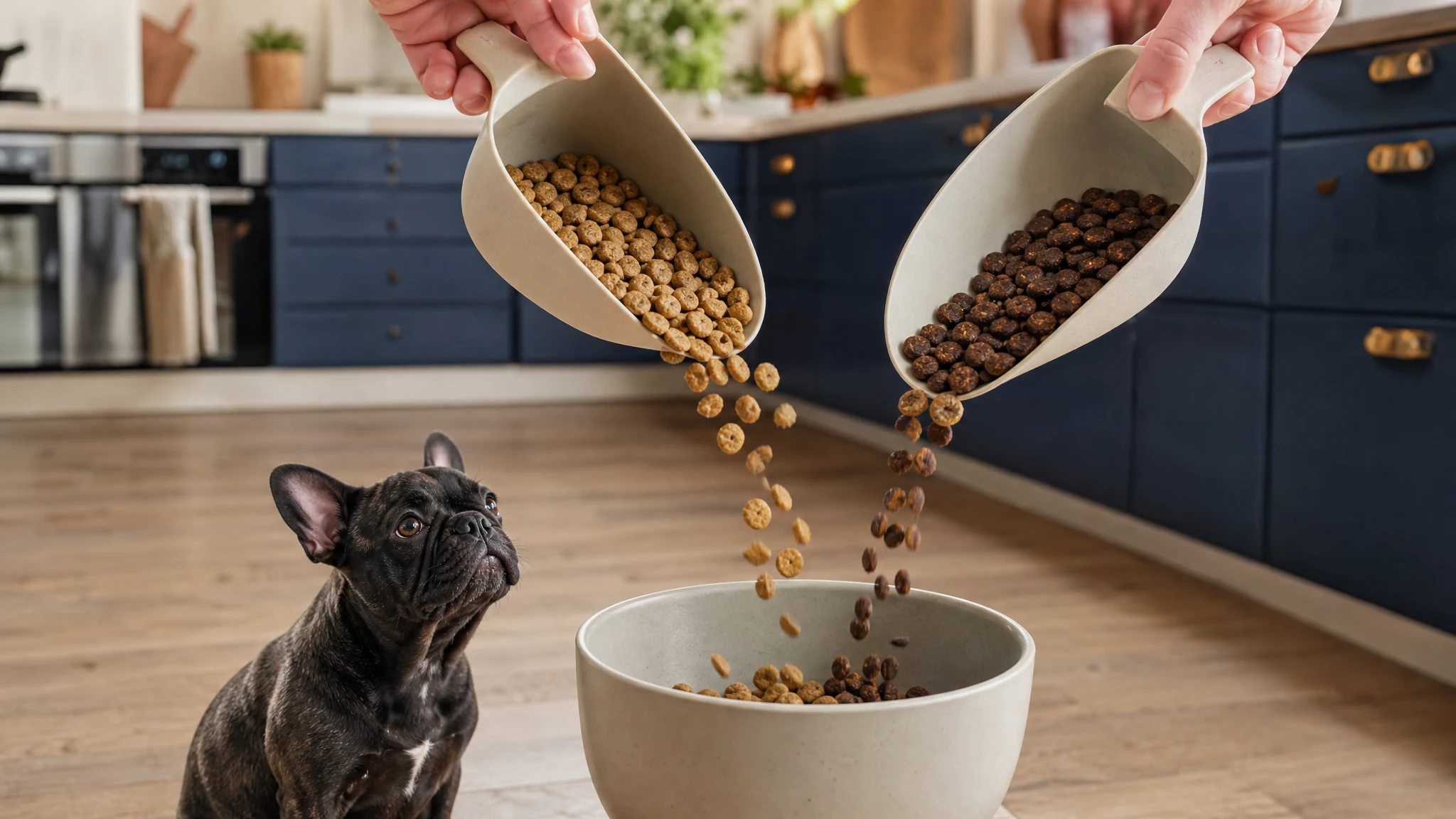
General nutrition information compiled from product labels and published sources, not veterinary advice. Your veterinarian is the right person to choose a diet for your dog, especially one with a health condition.
Picking food for a French Bulldog puppy is not a one-time decision. Appetite, body size and the food itself all shift between the first weeks at home and the first birthday. This guide walks through those changes in order, so you can read labels calmly and adjust without guessing.
A note on method. We compared label data published by the brands and the breed sources listed at the end. We did not run feeding trials or taste tests, and nothing here replaces your veterinarian's advice for your own puppy.
What You Need Before You Start
- The food label (or the brand's product page) for the food you plan to use, with the nutritional adequacy statement, ingredient list, guaranteed analysis and calorie content.
- A measuring cup, or a kitchen scale if you prefer grams.
- A notebook or phone note to log meals, treats and weight.
- A raised or shallow, wide bowl you can wash daily. A flat-faced puppy may find a very deep bowl awkward, so watch how yours eats.
- Fresh water, always available.
- Your veterinarian's contact details, since they decide what is right for an individual dog.
Why a French Bulldog Puppy Is a Special Case
The French Bull Dog Club of America breed standard says a French Bulldog should not exceed 28 pounds. Royal Canin's US breed library gives typical adult ranges of 20 to 28 pounds for males and 17 to 24 pounds for females. That is a compact dog.
This matters because of how puppy food labels are worded. Since 2016, AAFCO requires growth and all-life-stages dog foods to say either "including growth of large-size dogs (70 pounds or more as an adult)" or "except for growth of large-size dogs." Whole Dog Journal explains that foods with the "including" wording meet the reduced calcium limits meant for large dogs. A French Bulldog will never reach 70 pounds, so the "except for growth of large-size dogs" wording is not a red flag for this breed. A large-breed puppy formula is not required.
The breed also has diet-relevant quirks. Royal Canin notes that the flat-faced build makes French Bulldogs prone to respiratory problems, and that many dogs with brachycephalic airway obstruction syndrome also show gastrointestinal signs. Royal Canin also warns that the breed gains weight easily. A UK VetCompass study reported by Phys.org found French Bulldogs had 11.18 times the odds of skin dermatitis compared with other breeds. None of this means a particular food prevents or treats these problems. It means you should watch your puppy closely and bring changes to your vet.
Step 1: Confirm the Food Is Complete for Growth
Find the nutritional adequacy statement on the bag or the brand's page. For a puppy you want wording that covers growth, either "growth" or "all life stages."
The statements come in two types. Some foods say they were formulated to meet the AAFCO Dog Food Nutrient Profiles. Others say animal feeding tests using AAFCO procedures substantiate the food. Both are legitimate routes, and the statement alone does not tell you which food suits your puppy.
For example, Royal Canin's French Bulldog Puppy dry food states it meets the AAFCO profiles for growth, including growth of large-size dogs. Victor's Hi-Pro Plus Small & Medium Breed Puppy states it meets the profiles for all life stages, except for growth of large-size dogs. For a French Bulldog, both wordings are workable on this point.
Step 2: Read the Label Like a Skeptic
Marketing sits on the front of the bag. The useful details sit on the back.
- Ingredient list. Ingredients are listed by weight, so the first five tell you the main building blocks. Royal Canin's French Bulldog Puppy lists brewers rice, chicken by-product meal, wheat, chicken fat and chicken meal. Hill's Science Diet Puppy Chicken & Brown Rice lists chicken, brown rice, whole grain wheat, chicken meal and chicken fat.
- Guaranteed analysis. Royal Canin's French Bulldog Puppy lists a minimum of 28.0% protein, a minimum of 18.0% fat and a maximum of 3.4% fiber. Victor's small and medium breed puppy formula lists 30.0% protein minimum, 18.0% fat minimum and 5.0% fiber maximum.
- Calories. Calories per cup decide how much you feed, so check them before you buy.
One caution. Hill's product pages give dry-matter averages rather than guaranteed minimums and maximums. A dry-matter figure is not directly comparable to an as-fed guaranteed analysis, so do not line them up number for number.
Step 3: Compare a Few Options Fairly
The table below uses only the label data the brands publish. Blank-looking entries mean the brand page did not state the number, so check with the brand.
| Food | Type | Calories | Protein / fat / fiber |
|---|---|---|---|
| Royal Canin French Bulldog Puppy | Dry | 373 kcal per cup (calculated) | 28.0% min / 18.0% min / 3.4% max |
| Hill's Science Diet Puppy Chicken & Brown Rice | Dry | 390 kcal per cup | Dry-matter averages: 28.1% / 19.1% / 2.7% |
| Victor Hi-Pro Plus Small & Medium Breed Puppy | Dry | 383 kcal per cup | 30.0% min / 18.0% min / 5.0% max |
| Freshpet Multi-Protein Puppy Recipe | Fresh | 241 kcal per cup (calculated) | 16% min / 10% min / 2% max |
Notice how much the calories per cup differ. A cup of one food is not a cup of another, so never swap foods and keep the same scoop.
Royal Canin describes its French Bulldog puppy kibble as a curved shape designed for the breed's short muzzle and underbite. That is the brand's claim about design. Brands do not publish a kibble size in measurements for most of these foods, so watch how your puppy actually picks up and chews the pieces.
You can read the full details on the brand pages for Royal Canin French Bulldog Puppy, Hill's Science Diet Puppy, Victor Hi-Pro Plus Small & Medium Breed Puppy and Freshpet Multi-Protein Puppy Recipe.
Step 4: Start With the Label Feeding Guide
The feeding chart is a starting point, not a prescription. Brands build it from average dogs, and your puppy may need more or less.
Royal Canin's French Bulldog Puppy page gives a daily feeding table by puppy age (2 to 9 months) and target adult weight (18, 22 and 31 pounds). As one example from that table, a 3-month-old puppy with an 18-pound adult target is listed at 1 1/2 cups (144 g) per day. Your puppy's numbers will depend on the food you pick and your vet's estimate of the adult weight.
Split the daily total into several meals. Hill's advises adjusting amounts as necessary to maintain optimal weight and to ask your veterinarian if you are unsure. Victor's page for its Hi-Pro Plus formula suggests feeding as much as the puppy will eat in 20 minutes across four feedings a day, which is a different approach from measured portions. If your French Bulldog gains weight easily, talk with your vet before choosing a free-feeding style.
Step 5: Adjust as Your Puppy Grows
Royal Canin's life-stage table lists the puppy stage as 2 to 12 months and the adult stage as 12 months to 8 years. Here is what tends to change along the way.
Weeks to about 4 months
Growth is fast and meals are small and frequent. Keep the food consistent and the portions measured. If your breeder or rescue sent you home with a specific food, ask the vet before switching.
About 4 to 8 months
Appetite may swing, and the daily amount on the chart usually changes with age. Re-weigh your puppy regularly and compare against the French Bulldog puppy growth chart by month. Use it as a rough guide, since healthy puppies vary.
About 8 to 12 months
Growth slows. This is when the breed's tendency to gain weight easily can show up, so body condition matters more than the number on the chart. Ask your vet when to move to an adult formula. Victor's page, for example, says that after age one you should feed to maintain good body condition using the chart as a guide.
Step 6: Switch Foods Gradually
Whenever you change foods, do it slowly. A French Bulldog with a sensitive stomach may react to sudden changes, and Royal Canin notes that gastrointestinal signs are common in dogs with brachycephalic airway obstruction.
- Days 1 to 3: mostly the old food with a small portion of the new.
- Days 4 to 6: about half and half.
- Days 7 to 9: mostly the new food with a little of the old.
- Day 10 onward: the new food alone, if stools and appetite are normal.
If you see ongoing vomiting, loose stools, itching or a drop in appetite, stop and call your vet. Do not try to treat it with a diet change on your own.
A Word on Grain-Free and DCM Headlines
You may see worry about grain-free diets and canine dilated cardiomyopathy (DCM). The FDA Center for Veterinary Medicine's last public update on its investigation is dated 12/23/2022, and the agency says it will not publish further public updates until there is meaningful new scientific information. The page does not tell you which food to choose for your puppy.
A fair reading is to look at the full label, avoid assuming any trend decides your dog's health, and ask your veterinarian. Among the foods above, the label data lists Freshpet's Vital Puppy recipe as grain free, and that detail is inferred from the brand's page address. Check the brand if it matters to you.
Common Mistakes to Avoid
- Choosing a large-breed puppy formula by default. A French Bulldog is capped at 28 pounds by the breed standard, so this is not needed.
- Using a different cup size. Calories per cup vary widely between foods, so measure with the same tool.
- Ignoring treats. Treats add calories fast for a small dog that gains weight easily. Count them in the daily total.
- Comparing mismatched numbers. As-fed minimums and dry-matter averages are not the same thing.
- Switching in a hurry. A quick change can upset the stomach.
- Trusting front-of-bag claims. Words like "natural" or "premium" are not nutritional measures. Read the adequacy statement.
- Adding supplements without asking. Complete puppy foods are formulated to be balanced. Only your vet should advise on additions.
- Treating symptoms with food. Skin problems, ear discharge or digestive upset call for a vet visit, not a new bag.
What to Expect
With a complete growth formula, measured portions and regular weigh-ins, many owners find their puppy's growth and stools settle into a steady pattern within a few weeks. That is not a promise. Every puppy is different, and food is only one part of health.
A puppy that is eating well, has formed stools and a healthy body condition is generally a good sign, but your vet is the one to confirm it. If your puppy seems underweight or overweight, or you have questions about a specific condition, ask your veterinarian. Prescription diets are something only a veterinarian can prescribe.
Quick Checklist
- Check that the label says "growth" or "all life stages."
- Read the first five ingredients and the guaranteed analysis.
- Note the calories per cup and measure portions.
- Start with the feeding guide, then adjust with your vet.
- Weigh regularly and compare with the growth chart.
- Switch foods over about 10 days.
- Ask your vet when to move to adult food, around 12 months.
Sources
- French Bull Dog Club of America, French Bulldog Breed Standard
- Royal Canin US breed library, French Bulldog
- Royal Canin US, French Bulldog Puppy dry dog food
- Hill's Pet, Science Diet Puppy Chicken & Brown Rice Recipe
- Victor Pet Food, Hi-Pro Plus Small & Medium Breed Puppy
- Freshpet, Multi-Protein Puppy Recipe With Green Beans & Carrots
- Whole Dog Journal, In the Fine Print: Nutritional Adequacy Statements
- FDA Center for Veterinary Medicine, investigation into diets and canine dilated cardiomyopathy
- Phys.org report on O'Neill et al., Canine Medicine and Genetics (16 Dec 2021)