Bowl Manners and Food Guarding: Mealtime Training for a French Bulldog Puppy
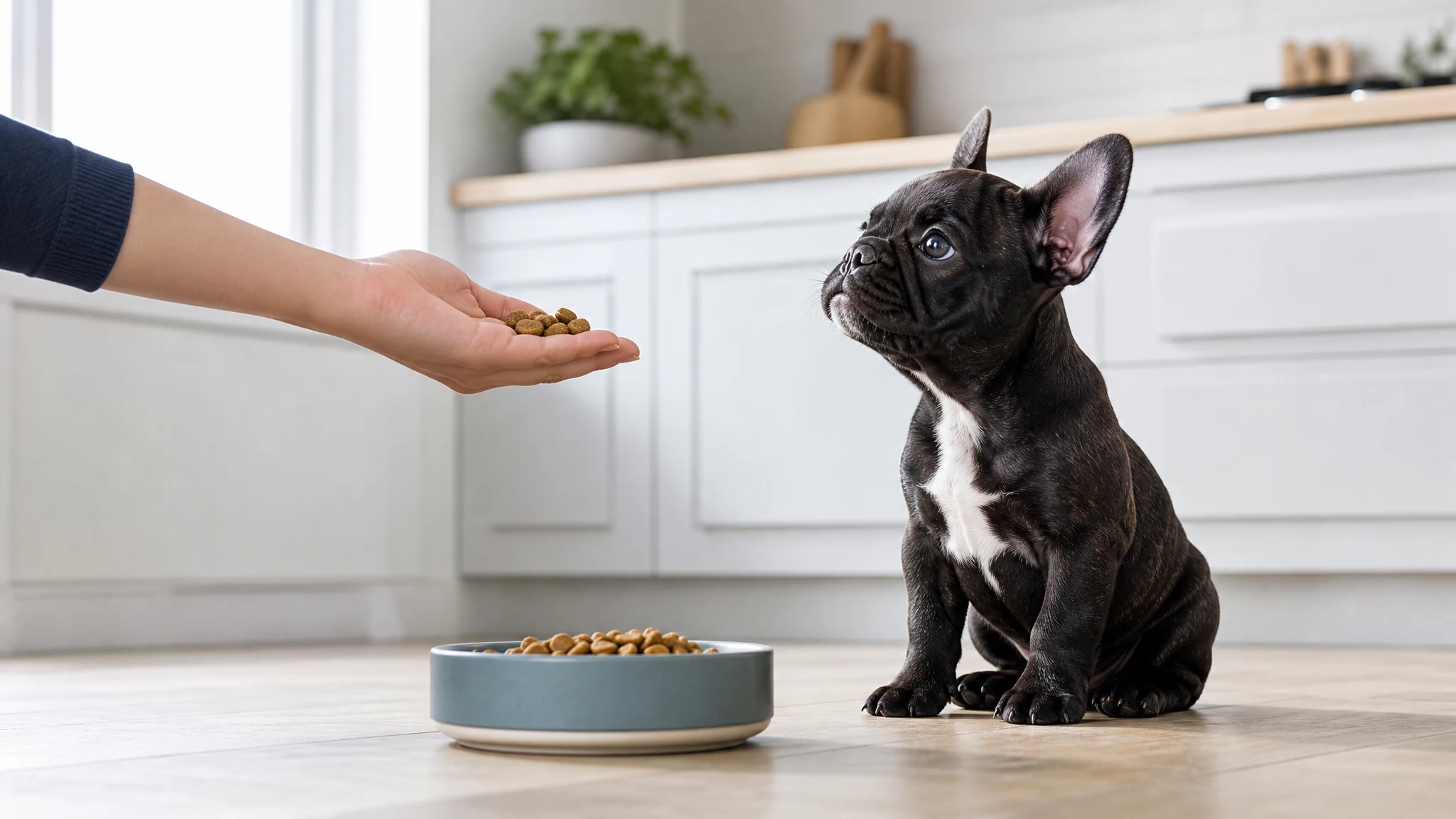
General nutrition information compiled from product labels and published sources, not veterinary advice. Your veterinarian is the right person to choose a diet for your dog, especially one with a health condition.
Most French Bulldog puppies are not trying to be rude at the bowl. They are small, hungry and quick, and a bowl of food is the best thing in the room. The trouble starts when a puppy learns that people near the bowl mean the food is about to vanish.
This guide covers two linked problems: puppy food guarding and a French Bulldog puppy eating too fast. Both can be shaped with calm, reward-based habits. Nothing here uses force, and nothing here replaces advice from your veterinarian about your own dog.
What food guarding looks like in a puppy
Food guarding is a puppy's way of saying "this is mine, please stay back." Early signs are easy to miss:
- Freezing or going stiff when someone walks past the bowl
- Eating faster with the head low and body curved over the food
- Staring at you out of the corner of the eye, sometimes showing the whites
- Lip lifting, a low growl, or a snap if someone gets close
Owners often search for "food aggression" when they see this. The label sounds alarming, but in a young puppy it is usually worry about losing a resource, and worry responds well to teaching. A growl is information. Punishing it can teach the puppy to hide the warning and skip straight to a bite, so we never do that.
Why gulping and guarding often show up together
A puppy who eats in ten seconds is not enjoying a meal, and a puppy who feels watched may speed up on purpose. The two habits feed each other. Slowing the meal down and making people-near-the-bowl a good thing tackles both at once.
French Bulldogs also have a flat-faced build. Royal Canin's breed library notes that the breed is prone to respiratory problems from that build and that many dogs with brachycephalic airway obstruction syndrome also show gastrointestinal signs. So if your puppy gags, regurgitates, wheezes during meals or seems to struggle to breathe while eating, mention it to your veterinarian rather than assuming it is only bad manners.
Materials you will need
- The puppy's regular food, measured for the day. Use the feeding guide on the label as a starting point, and let your veterinarian adjust it. If you are still choosing a food, our label-by-label comparison of puppy foods for French Bulldogs explains how to read the labels.
- A few extra-special treats that are different from the kibble, such as small pieces of plain cooked chicken. Take their calories out of the day's portion so the puppy does not gain extra weight. Royal Canin's breed library warns that French Bulldogs gain weight easily.
- A slow feeder, lick mat or puzzle bowl with shallow ridges. Deep, narrow designs can be awkward for a short muzzle, so pick a shape your puppy can actually reach into.
- A non-slip mat to keep the bowl from sliding.
- A quiet corner away from the doorway and foot traffic.
- A baby gate or exercise pen if there are children or other pets in the home.
Step-by-step mealtime training
Step 1: Set up a calm feeding spot
Pick one place and use it every meal. A corner of the kitchen or a spot near a wall works well. The puppy should be able to eat without being stepped over, and without a child or another pet wandering up to the bowl.
Keep the routine steady: the same spot, the same mat, roughly the same times. Predictability lowers worry, and a puppy who is not worried has less reason to guard.
Step 2: Make the meal slower
If your puppy gulps, put the food in a slow feeder, a lick mat or a puzzle toy instead of a plain bowl. You can also scatter a small portion across a clean, washable mat so the puppy has to sniff and pick up each piece.
Do not try to fix gulping by splitting the food into a tiny bowl and waiting. Just change how the food is delivered. Ask your veterinarian how many meals a day suit your puppy at their age. Many puppies do better with several smaller meals than one or two big ones.
A note on kibble shape: Royal Canin describes its French Bulldog puppy kibble as curved, designed for the breed's short muzzle and underbite. That is the brand's own description. It tells you about how the kibble is shaped, not about how fast any individual puppy will eat it.
Step 3: Teach "wait" before the bowl goes down
Hold the bowl at chest height. When the puppy sits, even for a second, say "yes" and lower the bowl. If the puppy jumps up, simply lift the bowl and wait for four paws on the floor. No scolding, no pushing.
Over several days, ask for slightly longer waits. This is also a small impulse-control lesson, so it counts as training, not just feeding. Keep sessions short, because a hungry puppy runs out of patience quickly.
Step 4: Use meals as training time
Your puppy has to eat several times a day, which gives you several free training sessions. Instead of putting the whole meal in a bowl every time, use part of it as rewards for sit, down, come and name response. A puppy who is working with you for food learns that you are the source of good things.
Keep the portion total the same. Measuring the day's food in the morning and drawing from it for rewards keeps the calories honest.
Step 5: Hand-feed a few bites each day
Hand-feeding teaches your puppy that hands near food are a good sign. At one meal a day, put the puppy's bowl down with only a handful of kibble in it. As the puppy eats, add another handful from your hand into the bowl. Then add one more.
You can also sit beside the puppy and feed several pieces one by one straight from your fingers. This is especially useful for a puppy who has started to stiffen at the bowl, and it takes less than a minute.
Step 6: Trade up, never take
This is the central skill for puppy food guarding. The idea is to make giving something up the start of a better thing.
- Stand a step or two away while the puppy eats. If the puppy is relaxed, toss a small, tasty treat near (not into) the bowl.
- Walk past, toss another treat, and keep walking. The puppy learns that footsteps predict treats.
- Over days, move a little closer. Approach, drop the treat into the bowl, and step back.
- Later, pause at the bowl, offer a treat from your hand, and let the puppy go back to the meal.
- With a puppy who is comfortable, you can occasionally lift the bowl, add something special to it, and put it straight back down.
If the puppy ever stiffens, stop and go back to the last step that felt easy. You are building a good feeling about your approach, so a distance where the puppy stays relaxed is always the right distance to start from.
Step 7: Teach everyone in the home the same rules
Adults can practice the trade-up game. Children should not approach the puppy's bowl, or reach for chews and toys, at all. Feed the puppy behind a gate or in a separate room if needed. Supervision matters more than any exercise on this page.
Tips that help
- Keep the treat better than the food. A trade only works when the new item is more exciting than the current one.
- Practice with chews and toys too. Guarding often spreads past the food bowl.
- Stay quiet and relaxed. A puppy reads tension in your body.
- Pick up the bowl when it is empty, and give the puppy a minute to finish before you walk off with it.
- Feed at consistent times. A puppy who knows when the next meal is coming has less reason to panic.
Common mistakes to avoid
- Repeatedly pulling the bowl away "to show who is boss." This teaches the puppy that people really do take food. It makes guarding more likely, not less. The American Veterinary Society of Animal Behavior (AVSAB) recommends reward-based training and advises against dominance methods.
- Using punishment, startling or physical corrections. These raise fear and can hide warning signs.
- Hand-reaching into the bowl without a trade. Reaching in with nothing to give teaches nothing.
- Letting the puppy practice guarding. Every rehearsal makes the habit stronger, so manage the situation with gates, space and separate feeding.
- Changing foods suddenly. A new bag means a new routine and sometimes an upset stomach. Check the brand's feeding guide and ask your veterinarian before you switch.
- Ignoring gulping that looks like distress. Coughing, gagging or vomiting after meals deserves a call to the veterinarian.
What results to expect
Many puppies relax around people at the bowl within a few weeks of daily practice, and a slow feeder often makes meals last noticeably longer. Progress varies from dog to dog, though, and no routine can promise a particular outcome. Some puppies need months, and some will always like a little space while they eat. That is a reasonable thing to respect.
Success looks like a loose, wiggly puppy who looks up at you when you walk by, not one who is simply too frightened to growl.
When to call a professional
Ask your veterinarian first if the guarding appears suddenly, if your puppy seems uncomfortable when eating, or if gulping comes with coughing, gagging or vomiting. Pain and illness can change behavior.
Then consider a qualified, reward-based behavior professional if:
- The puppy bites, or snaps with force, rather than only freezing or growling
- The guarding is spreading to toys, furniture, people or spaces
- There are young children in the home and you are not sure the setup is safe
- You feel anxious about feeding time, or the exercises are making things worse
When you look for help, ask what methods they use. Avoid anyone who talks about dominance, alpha rolls, scruffing, or shock, prong or choke collars. The AVSAB position is that these methods carry risk and are not needed.
A note on how we approach food information
This guide draws on published breed information and on the labels and product pages of the brands mentioned, not on our own feeding trials or taste tests. Food and portion decisions for an individual puppy belong to your veterinarian.