Dry Food for a French Bulldog Puppy: Portions and Feeding Tips
General nutrition information compiled from product labels and published sources, not veterinary advice. Your veterinarian is the right person to choose a diet for your dog, especially one with a health condition.
Choosing the best dry food for a French Bulldog puppy is only half the job. The other half is feeding it well: measuring meals, reading the label's chart, and adjusting as your puppy grows.
This guide walks through that process step by step. We compared label data from brand pages. We did not run feeding trials or taste tests, so nothing here is a ranking or a promise about how a food will work for your dog.
What You Need
- The bag of dry puppy food you plan to use, with its nutritional adequacy statement and feeding chart.
- A standard dry measuring cup, or better, a kitchen scale that reads in grams.
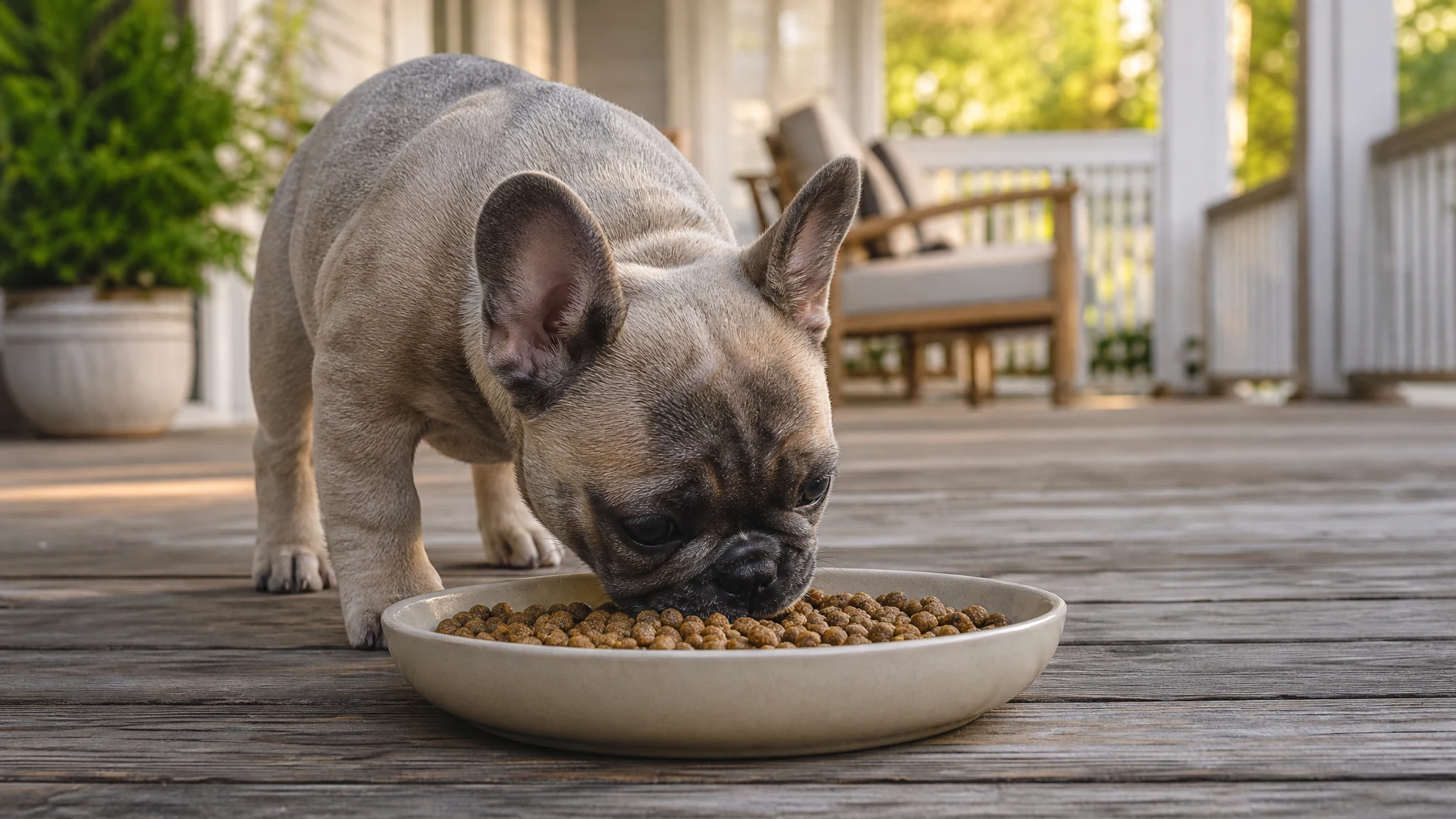
- A shallow, stable bowl. A flat-faced puppy may find a very deep bowl awkward.
- A notebook or phone note to log meals and weight.
- Your puppy's current weight and age, plus a realistic idea of adult size.
- Your veterinarian's contact details for questions about your individual puppy.
Step 1: Know the Size You Are Feeding For
The French Bull Dog Club of America breed standard says a French Bulldog should not exceed 28 pounds. The Royal Canin US breed library lists adult males at 20 to 28 pounds and females at 17 to 24 pounds.
That matters for food choice. The AAFCO large-size category covers dogs expected to reach 70 pounds or more as adults. Whole Dog Journal explains that since 2016 growth and all-life-stages labels must say either "including growth of large-size dogs" or "except for growth of large-size dogs."
A French Bulldog is far below that 70 pound line. So an "except for growth of large-size dogs" statement is not a problem for this breed, and a large-breed puppy formula is not needed.
Step 2: Check the Label Before You Buy
Start with the nutritional adequacy statement. It should say the food meets the AAFCO Dog Food Nutrient Profiles for growth or for all life stages, or that feeding tests substantiate it for growing puppies. An adult maintenance food is not the right fit for a puppy.
Then look at the first ingredients, the guaranteed analysis, and the calories per cup. Be skeptical of front-of-bag claims. Words like "premium" or "natural" are marketing, not nutrition data.
A label comparison of dry options
The figures below come from each brand's own product page. Royal Canin and Victor list guaranteed minimums and maximums. Hill's lists dry-matter averages instead, so its protein and fat numbers are not directly comparable to the others.
| Food | First ingredients | Protein / fat / fiber | Calories per cup |
|---|---|---|---|
| Royal Canin Breed Health Nutrition French Bulldog Puppy | Brewers rice, chicken by-product meal, wheat, chicken fat, chicken meal | 28% min / 18% min / 3.4% max | 373 kcal ME (calculated) |
| Victor Hi-Pro Plus Small & Medium Breed Puppy | Beef, chicken, beef meal, chicken meal, whole grain sorghum | 30% min / 18% min / 5.0% max | 383 kcal |
| Victor Hi-Pro Plus | Beef meal, grain sorghum, chicken fat, whole grain millet, blood meal | 30% min / 20% min / 3.8% max | 406 kcal |
| Hill's Science Diet Puppy Chicken & Brown Rice | Chicken, brown rice, whole grain wheat, chicken meal, chicken fat | Dry-matter averages: 28.1% / 19.1% / 2.7% | 390 kcal |
| Hill's Science Diet Puppy Small & Mini Chicken & Brown Rice | Chicken, whole grain oats, brown rice, chicken meal, chicken fat | Dry-matter averages: 28.9% / 19.7% / 2.3% | 418 kcal |
A few things stand out. Calories per cup range from 373 to 418 across these foods. That is a real difference, so a cup of one food is not a cup of another.
Royal Canin describes its French Bulldog puppy kibble as a curved shape designed for the breed's short muzzle and underbite. It does not give a kibble size in numbers. The brand pages for the other foods do not state a kibble size either, so check with the brand if size matters to you.
Both Victor foods carry an "all life stages, except for growth of large size dogs" statement. Victor's page for the small and medium formula also contains a protein-to-fat sentence (26% protein) that does not match its 30% guaranteed minimum. Trust the guaranteed analysis on the bag and ask the brand if you are unsure.
Royal Canin's French Bulldog puppy formula, Victor and Hill's are all brands with their own pages. You can read their full labels on the Royal Canin French Bulldog Puppy page, the Victor Hi-Pro Plus Small & Medium Breed Puppy page and the Hill's Science Diet Puppy page.
No single food on this table is the answer for every puppy. The best dry food for a French Bulldog puppy is one with a complete and balanced statement for growth, a calorie level you can portion accurately, and a result your own veterinarian is happy with.
Step 3: Find the Starting Portion on the Feeding Chart
Every brand's chart is built around age and expected adult weight. Use it as a starting point, not a rule.
Royal Canin's French Bulldog puppy chart covers ages 2 to 9 months and target adult weights of 18, 22 and 31 pounds. One example from the chart: a 3-month-old puppy with an 18 pound target gets 1 1/2 cups (144 g) per day.
Notice that the chart's 31 pound column is above the 28 pound ceiling in the breed standard. Most French Bulldogs fall in the lower columns, but check the chart for your puppy's likely adult size and ask your breeder or vet if you are unsure.
Do a quick calorie check too. At 373 kcal per cup, that 1 1/2 cups works out to roughly 560 kcal a day. This is simple arithmetic from the label, useful for comparing foods, not a target for your puppy.
Hill's pages tell owners to adjust amounts as necessary to maintain optimal weight, and to ask a veterinarian if unsure. Victor's page for Hi-Pro Plus suggests feeding as much as the puppy will eat in 20 minutes, in four feeding intervals spaced through the day. That is one brand's guide for its own food. Other brands may differ, so follow the chart on your bag.
For a broader look at amounts by age, see our French Bulldog puppy feeding chart guide.
Step 4: Measure Every Meal
- Take the daily amount from the chart.
- Divide it into the number of meals your vet or the bag suggests.
- Weigh the portion on a scale if you can. Grams are more consistent than scooping, which can vary from one scoop to the next.
- If you use a cup, level it off. Do not heap it.
- Serve in the same place at about the same times each day.
- Pick up the bowl when the meal is over, and keep fresh water available.
Count training treats as part of the day's food. Small rewards add up quickly in a small dog.
Step 5: Watch Your Puppy, Not Just the Chart
Royal Canin's breed library warns that the breed gains weight easily. A UK VetCompass finding cited in that same material is mixed, so it is worth treating weight as something to watch rather than assume.
Weigh your puppy regularly and log it. Look at body shape from above and from the side. Ask your vet to show you what a healthy waist and rib feel look like on a flat-faced, stocky dog.
If weight climbs faster than your vet likes, the label guide may need adjusting. If your puppy seems hungry all the time or is losing condition, call your vet rather than guessing.
Step 6: Adjust for the Breed's Quirks
The Royal Canin breed library notes that French Bulldogs are prone to respiratory problems because of the flat-faced build. It also links brachycephalic airway obstruction to gastrointestinal signs. In plain terms, eating and digestion can be harder for some of these dogs.
Practical habits that may help:
- Use a shallow bowl, and offer food in a calm spot away from rowdy play.
- Avoid feeding right after hard exercise or in hot weather, when breathing is already working hard.
- Note gulping, gagging, regurgitation or loose stools in your log and share it with your vet.
Skin is another concern. A Phys.org report on UK VetCompass research (O'Neill et al.) said French Bulldogs had 11.18 times the odds of skin dermatitis compared with other breeds. The Royal Veterinary College also lists skin fold dermatitis as a predisposition.
No food prevents or treats skin, airway or digestive problems on its own. A veterinarian decides whether a diet change makes sense for an individual dog. Prescription diets are only something a vet prescribes.
Step 7: Change Foods Slowly and Review at 12 Months
Royal Canin's life-stage table lists the puppy stage as 2 to 12 months for this breed and adult as 12 months to 8 years. Hill's recommends its puppy foods for puppies up to 1 year old.
When it is time to switch, or if you ever change puppy foods, mix the new food in with the old over several days and watch stools and appetite. Ask your vet when to move to an adult food for your particular dog.
Common Mistakes to Avoid
- Using an adult food. Check for a growth or all-life-stages statement.
- Worrying about the large-breed wording. The "except for growth of large-size dogs" line does not apply to a dog that will stay under 28 pounds.
- Comparing cups across brands. Calories per cup differ, so recalculate when you switch foods.
- Comparing Hill's dry-matter averages with other brands' guaranteed minimums. They are different kinds of numbers.
- Forgetting treats. They count toward daily intake.
- Free-feeding without a plan. A bowl left out all day makes portions hard to track.
- Following a chart over your puppy's body condition. The chart is a start.
- Adding supplements on your own. Ask your vet first. We do not give supplement amounts.
About Grain-Free and DCM Questions
You may see worry online about diet and a heart condition called dilated cardiomyopathy (DCM). The FDA's page on its investigation into a potential link between certain diets and DCM was last updated on 12/23/2022. The agency says it will not publish further public updates until there is meaningful new scientific information.
If you are weighing a grain-free diet for your puppy, ask your veterinarian, who knows your dog's history. The dry foods in the table above are all listed as not grain-free.
What to Expect
With measured portions and a food that matches your puppy's life stage, many owners see steady growth, regular meals and consistent stools. Results vary from dog to dog, and a label cannot predict them.
A reasonable goal is a puppy that grows steadily, keeps a healthy body shape and eats without distress. If your puppy has a health condition such as breathing trouble, skin problems or digestive upset, confirm food type and amounts with your vet before relying on any chart.
Check back with your vet at routine visits. Weight and growth checks are the best way to know whether your starting portion is working.
Sources
- French Bull Dog Club of America, French Bulldog Breed Standard
- Royal Canin US breed library, French Bulldog
- Royal Canin US, French Bulldog Puppy Dry Dog Food
- Victor Pet Food, Hi-Pro Plus Small & Medium Breed Puppy
- Victor Pet Food, Hi-Pro Plus
- Hill's Pet, Science Diet Puppy Chicken & Brown Rice
- Hill's Pet, Science Diet Puppy Small & Mini Chicken & Brown Rice
- Whole Dog Journal, In the Fine Print: Nutritional Adequacy Statements
- Royal Veterinary College, French Bulldogs: VetCompass reveals top health problems
- Phys.org report on O'Neill et al., Canine Medicine and Genetics
- FDA Center for Veterinary Medicine, investigation into diets and canine dilated cardiomyopathy