French Bulldog Puppy Food: What to Look for on the Label

General nutrition information compiled from product labels and published sources, not veterinary advice. Your veterinarian is the right person to choose a diet for your dog, especially one with a health condition.
Choosing French Bulldog puppy food starts with the bag, not the front of it. The front is marketing. The back has the AAFCO statement, the ingredient list, the guaranteed analysis and the calories. Those are the parts worth comparing.
This guide shows how to read them for a breed that tops out at a small adult size. It then lays out what several brands print on their own pages. It is not medical advice. Your veterinarian decides what is right for an individual puppy.

How we compared these foods
We compared label data published on each brand's own product page. We did not run feeding trials or taste tests, and we did not feed any of these foods to a dog. Where a brand does not publish a number, we say so instead of guessing.
For a side-by-side look at specific recipes, see our label comparison of food for French Bulldog puppies.
What makes a French Bulldog puppy different
The French Bull Dog Club of America breed standard says the dog should not exceed 28 pounds. The Royal Canin US breed library lists males at 20 to 28 pounds and females at 17 to 24 pounds. Royal Canin's life-stage table treats puppyhood as 2 to 12 months.
That adult size matters for one label detail. AAFCO's large-size category covers dogs expected to reach 70 pounds or more as adults. Whole Dog Journal explains that since 2016, growth and all-life-stages labels must say either "including" or "except for" growth of large-size dogs. A French Bulldog is far below 70 pounds. So a puppy does not need a large-breed growth formula, and an "except for growth of large-size dogs" statement is not a problem for this breed.
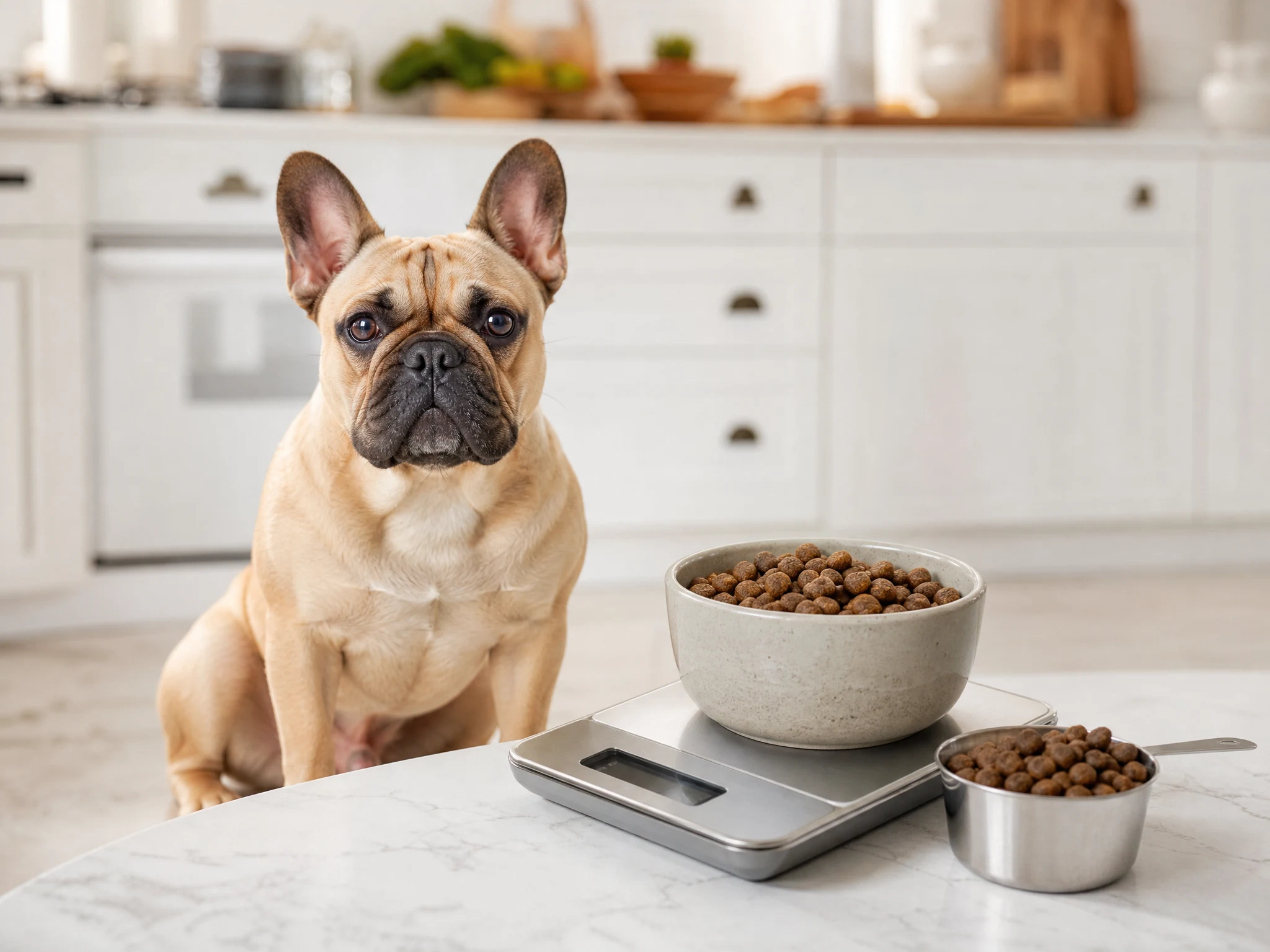
The Royal Canin breed library also notes that the breed gains weight easily. That makes calorie density and portion control worth watching from the start.
What to look for: quality indicators
1. A complete and balanced statement
Find the AAFCO nutritional adequacy statement. For a puppy you want one of two things:
- A food formulated to meet AAFCO Dog Food Nutrient Profiles for growth, or
- A food formulated for all life stages.
Some labels say the food was substantiated by animal feeding tests using AAFCO procedures. Others say it was formulated to meet the profiles. Both are legitimate routes. They are simply different ways of backing the claim, and the label tells you which one applies.
A statement that says "adult maintenance" only is not a puppy food.
2. The first five ingredients
Ingredients are listed by weight before cooking. Look for named protein sources such as chicken, beef or salmon, and named fats such as chicken fat. A name tells you what you are getting. Words like "meat" or "animal fat" tell you less.
Do not over-read the list. A "by-product meal" or a grain is not automatically bad, and a fresh meat first is not automatically better. Fresh chicken contains a lot of water, so it can sit first on a list even when a meal ingredient supplies more protein after processing. Use the list to learn what the food is built from, then check it against the analysis.
3. Guaranteed analysis you can compare
The guaranteed analysis gives minimum protein and fat and maximum fiber and moisture. Compare foods of the same type only. A dry food, a wet food and a fresh food hold very different amounts of water, so their percentages are not directly comparable.
Some brands publish dry-matter averages instead of guaranteed minimums. Those are a different measure again. Do not set a dry-matter number beside an as-fed minimum and call one higher.
4. Calories per cup
Calories decide how much your puppy eats. Two foods with similar protein can differ by 40 or more kcal per cup, and over weeks that adds up. Pick the food by label, then use its calorie figure to portion it.
5. Calcium, when it is published
Whole Dog Journal notes that too much calcium can cause bone and joint abnormalities in large-breed puppies. For a French Bulldog, the more practical point is that the label says the food is complete for growth. Some brands publish calcium and some do not. If it is missing, check with the brand.
6. Kibble shape and size
The breed has a short muzzle and an underbite. Royal Canin designed a curved kibble for exactly that. Other brands in this guide do not publish a numeric kibble size. If you are unsure whether a puppy can pick up a given kibble, ask the brand or your veterinarian.
Key features to compare, side by side
These figures come from each brand's own product page. "Not published" means the page did not give a guaranteed minimum or maximum.
| Food | AAFCO statement | Protein | Fat | Calories |
|---|---|---|---|---|
| Royal Canin Breed Health Nutrition French Bulldog Puppy (dry) | Growth, including large-size dogs | 28% min | 18% min | 373 kcal per cup |
| Victor Hi-Pro Plus Small & Medium Breed Puppy (dry) | All life stages, except growth of large-size dogs | 30% min | 18% min | 383 kcal per cup |
| Victor Hi-Pro Plus (dry) | All life stages, except growth of large-size dogs | 30% min | 20% min | 406 kcal per cup |
| Hill's Science Diet Puppy Chicken & Brown Rice (dry) | Feeding tests, growth | Not published (28.1% dry-matter average) | Not published (19.1% dry-matter average) | 390 kcal per cup |
| Hill's Science Diet Puppy Small & Mini Chicken & Brown Rice (dry) | Feeding tests, growth | Not published (28.9% dry-matter average) | Not published (19.7% dry-matter average) | 418 kcal per cup |
| Freshpet Multi-Protein Puppy Recipe (fresh) | Growth | 16% min | 10% min | 241 kcal per cup |
Fresh and dry foods are in the same table for convenience only. The protein and fat figures for the Freshpet recipe reflect its moisture and should not be ranked against the dry foods.
Top picks by type and budget
We are not listing prices. The brand pages we compared do not state them, and prices change by store and bag size. Instead, here are groupings by food type, which is the biggest driver of cost. Work out cost per day yourself, using the label's feeding guide and the price you see.
Breed-specific dry food
Royal Canin Breed Health Nutrition French Bulldog Puppy is the only food here made for the breed. Its first five ingredients are brewers rice, chicken by-product meal, wheat, chicken fat and chicken meal. It lists 28% protein minimum, 18% fat minimum and 3.4% fiber maximum. It has 373 kcal per cup and a curved kibble shaped for a short muzzle and underbite.
Its feeding table runs by puppy age from 2 to 9 months and by target adult weight of 18, 22 or 31 pounds. For example, at 3 months with an 18 pound target, it lists 1 1/2 cups (144 grams) per day. Treat that as a starting point and adjust with your veterinarian.
General puppy dry food from a brand with feeding tests
Hill's Science Diet makes several puppy recipes whose labels cite AAFCO feeding tests. The Puppy Chicken & Brown Rice Recipe lists chicken, brown rice, whole grain wheat, chicken meal and chicken fat first, at 390 kcal per cup. The Puppy Small & Mini recipe is 418 kcal per cup, which is more energy-dense. Hill's page does not give a kibble size.
Hill's also makes a Sensitive Stomach & Skin puppy recipe with salmon first, at 405 kcal per cup. Whether a puppy needs a food like that is a question for your veterinarian, not the front of the bag.
Higher-protein dry foods
Victor's Hi-Pro Plus Small & Medium Breed Puppy lists 30% protein minimum, 18% fat minimum and 5% fiber maximum. It is an all-life-stages food, "except for growth of large size dogs", which fits this breed. Its first five ingredients are beef, chicken, beef meal, chicken meal and whole grain sorghum, at 383 kcal per cup.
One caution. The page text mentions a 26% protein figure while the guaranteed analysis says 30%. We used the guaranteed analysis. If the difference matters to you, ask Victor.
The standard Hi-Pro Plus lists 30% protein, 20% fat and 3.8% fiber at 406 kcal per cup. With 20% fat and 406 kcal per cup, it is among the richest foods here. For a breed that gains weight easily, portion size deserves attention.
Wet and fresh options
Hill's makes wet puppy foods, including a Puppy Chicken & Rice Stew at 321 kcal per 12.5 ounce can. Its Puppy Small & Mini Beef & Barley Entree is 223 kcal per 5.8 ounce can. These are counted per can, not per cup, so do not compare them with dry foods cup for cup.
Freshpet offers a Multi-Protein Puppy Recipe at 241 kcal per cup, and a Vital Puppy recipe stated as 1,420 kcal per kilogram, or 322 kcal per half pound. The Vital Puppy label says it is for all life stages, including growth of large-size dogs. It is listed as a grain-free recipe. For the Multi-Protein recipe, check the package for the full large-size wording.
Red flags to avoid
- No AAFCO statement at all. If the label does not say the food is complete and balanced for growth or all life stages, skip it as a main diet.
- An adult-only statement. "Adult maintenance" is not built for a growing puppy.
- Health promises on the front. No food prevents, treats or cures hip dysplasia, allergies, heart disease or bloat. Be wary of any package that implies otherwise.
- Vague ingredient names. Unnamed "meat" or "animal fat" tells you little.
- Numbers that disagree. If the description and the guaranteed analysis conflict, ask the brand which is right.
- Missing calories. A food that does not state kcal per cup, can or kilogram makes portioning guesswork.
- Large-breed fear. A "growth of large-size dogs" line is not a reason to reject or require a food for a dog under 28 pounds.
On grain-free foods: the FDA has investigated a potential link between certain diets and canine dilated cardiomyopathy. The agency's latest update is dated 12/23/2022, and it says it will not publish more public updates until there is meaningful new scientific information. That is not a verdict on any food. If you are weighing a grain-free recipe, ask your veterinarian.
Feeding amounts and food changes
Feeding charts are starting points. Hill's pages say to adjust amounts as necessary to maintain optimal weight, and to ask your veterinarian if unsure. Victor's Hi-Pro Plus page says to feed what the puppy will eat in 20 minutes over four feedings, which is a very different approach from measured portions. Compare the guidance, and ask your veterinarian which suits your puppy.
Watch body condition as your puppy grows. The Royal Canin breed library describes the breed as prone to weight gain, so measuring matters.
Royal Canin also links the flat-faced build to breathing trouble, and notes that many affected dogs show gastrointestinal signs. If your puppy has trouble eating or digesting food, that is a veterinary question, not something a label can settle. Prescription diets are something only a veterinarian prescribes.
Where to buy
Start with the brand's own website. Product pages show the current label, ingredient list and calories, and brands usually say how their food is sold. Check the package in your hands against that page, since formulas can change.
Your veterinarian is another good source. They can tell you whether a specific food suits your puppy and where it is available. Prices vary by seller and bag size, so compare cost per day, not cost per bag. We do not link to retailers or sell anything here.
Whatever you choose, buy a smaller bag first. That lets you see how your puppy takes to it before committing to a large one.
A quick checklist
- Find the AAFCO statement and confirm it says growth or all life stages.
- Read the first five ingredients for named sources.
- Compare protein, fat and fiber within the same food type only.
- Note kcal per cup, can or kilogram, then work out a daily portion.
- Check kibble shape if your puppy struggles with size.
- Ignore disease claims and ask your veterinarian about any health concern.
Sources
- French Bull Dog Club of America, French Bulldog Breed Standard
- Royal Canin US breed library, French Bulldog
- Royal Canin US, French Bulldog Puppy product page
- Hill's Pet, Science Diet Puppy Chicken & Brown Rice
- Hill's Pet, Science Diet Puppy Small & Mini
- Victor Pet Food, Hi-Pro Plus Small & Medium Breed Puppy
- Victor Pet Food, Hi-Pro Plus
- Freshpet, Multi-Protein Puppy Recipe
- Whole Dog Journal, In the Fine Print: Nutritional Adequacy Statements
- FDA Center for Veterinary Medicine, investigation into diets and canine dilated cardiomyopathy