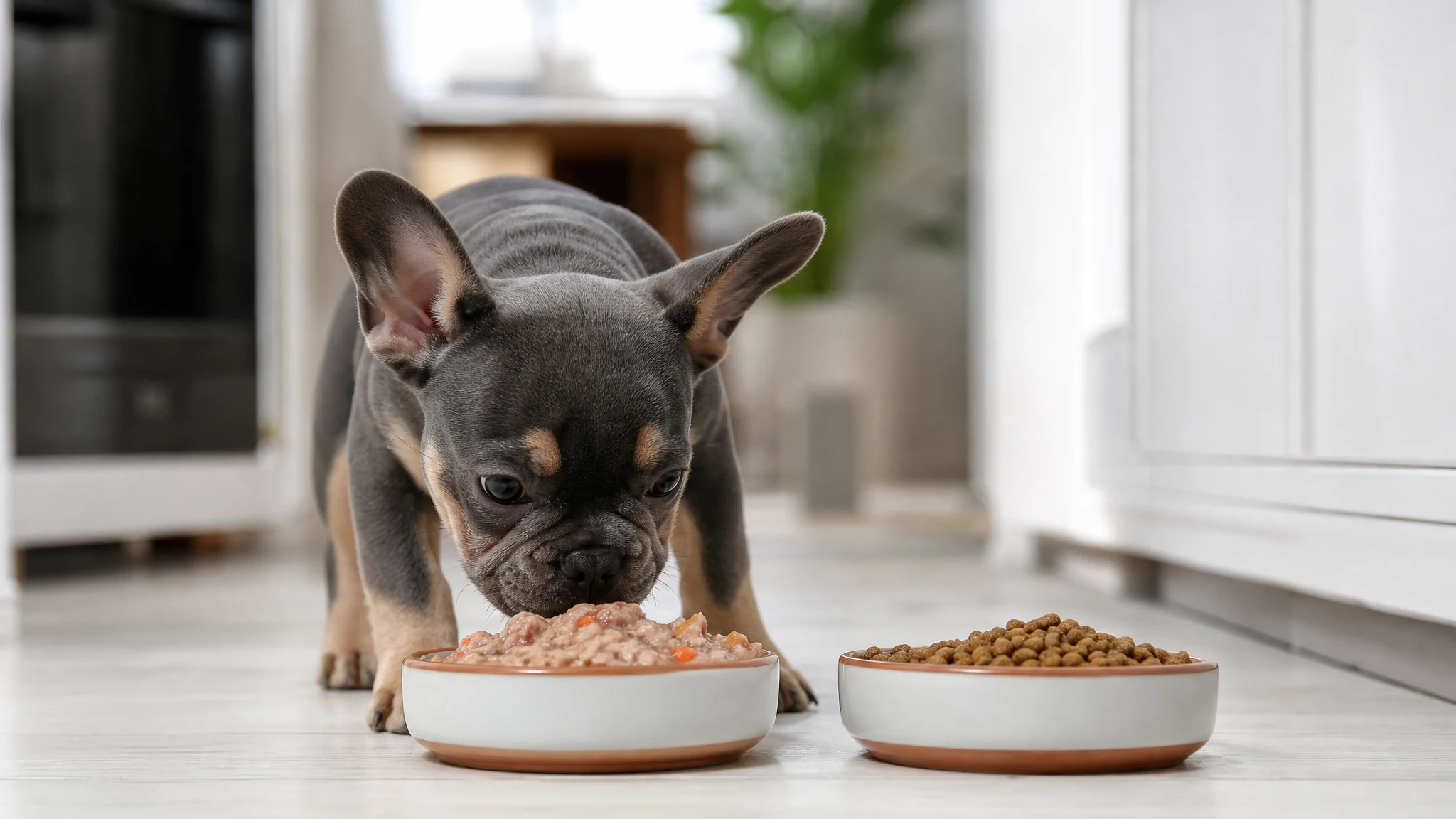
Dry, Wet and Fresh Puppy Food for French Bulldog Puppies: What the Labels Say
General nutrition information compiled from product labels and published sources, not veterinary advice. Your veterinarian is the right person to choose a diet for your dog, especially one with a health condition.
Most French Bulldog owners end up asking the same thing: should a puppy eat kibble, canned food or a refrigerated fresh roll? The marketing for each form is confident. The label data is more modest, and it answers fewer questions than you might expect.
This page compares the three forms using only published label data from the brands that make the products named below. We did not run feeding trials or taste tests, and we do not rank foods by how a dog reacts to them. We compared what the manufacturers print: AAFCO statements, ingredient order, calories and feeding notes.
What matters for a French Bulldog puppy
A few breed facts shape how to read a label.
- Adult size is small. The French Bull Dog Club of America breed standard says weight should not exceed 28 pounds. Royal Canin's breed library lists males at 20 to 28 lb and females at 17 to 24 lb. The AAFCO large-size category starts at 70 lb as an adult, so a French Bulldog puppy does not need a large-breed growth formula. An "except for growth of large-size dogs" statement is not a problem for this breed.
- The growth stage is short. Royal Canin's life-stage table for the breed puts puppyhood at 2 to 12 months.
- The face is short. Royal Canin describes its French Bulldog kibble as curved to suit "your French Bulldog's short muzzle and underbite." That is the brand's design claim, and it is the only breed-specific kibble shape in the data we have.
- Weight can creep up. Royal Canin warns that the breed gains weight easily. That makes calorie density and portion control worth more attention than they get on most labels.
- Breathing and digestion are linked. Royal Canin notes that many dogs with brachycephalic airway obstruction syndrome also show gastrointestinal signs. No food form has been shown on these labels to prevent or treat that. A veterinarian decides what suits an individual puppy.
The comparison at a glance
The table below covers the three forms. Figures come from the brand product pages. Where a page does not state a number, the table says so.
| Attribute | Dry | Wet (canned) | Fresh (refrigerated) |
|---|---|---|---|
| Water in the recipe | Not a leading ingredient | Water or broth is the first ingredient on both Hill's wet puppy labels | Not listed as a first ingredient on the Freshpet recipes |
| Calories, as fed | 373 to 418 kcal per cup in the products below | 223 kcal per 5.8 oz can; 321 kcal per 12.5 oz can | 241 kcal per cup (Multi-Protein); 322 kcal per 1/2 lb (Vital Puppy) |
| Calories per kilogram (where stated) | 3,721 (Hill's Puppy Chicken & Brown Rice); 3,730 (Victor Hi-Pro Plus Small & Medium Breed Puppy) | 908 to 1,360 | 1,420 (Vital Puppy); 929 per lb (Multi-Protein) |
| Kibble shape or size | Royal Canin: curved, made for the French Bulldog muzzle. Victor: "appropriate kibble size" for small and medium breeds. Hill's: not stated | Not applicable | Not applicable (sliced or scooped) |
| Breed-specific option | Yes, Royal Canin French Bulldog Puppy | No French Bulldog formula in our data; small and mini and regular puppy recipes only | No; puppy formulas, not breed-specific |
| Feeding guide format | Cups per day by age and target adult weight (Royal Canin) | Hill's: adjust amounts to maintain optimal weight | Freshpet: serving indicators on the package, or a measuring cup |
| Price per day | Not stated in the label data; check each brand's own page for current pricing | ||
Moisture: what the label can and cannot tell you
Wet food is mostly water. Hill's Science Diet Puppy Small & Mini Beef & Barley Entree lists water first, then beef. Hill's Puppy Chicken & Rice Stew lists chicken broth first. Ingredients are listed by weight, so that tells you water or broth makes up a large share of the can.
The product pages we relied on do not print a moisture percentage, so we will not guess one. The package label carries a maximum moisture figure in its guaranteed analysis, and that is the number to read.
Moisture also makes protein and fat percentages hard to compare. A dry food labeled 28% protein and a fresh food labeled 10.5% protein are not a fair contest, because the percentages are counted on different amounts of water. Freshpet lists protein minimums of 16% (Multi-Protein Puppy Recipe) and 10.5% (Vital Puppy). Royal Canin lists 28% for its French Bulldog Puppy dry food. These figures are not comparable as printed.
Hill's gives a cleaner comparison because its pages show dry-matter averages, which strip out the water:
- Puppy Chicken & Brown Rice (dry): protein 28.1%, fat 19.1%
- Puppy Small & Mini Beef & Barley Entree (wet): protein 28.5%, fat 22.5%
- Puppy Chicken & Rice Stew (wet): protein 29.9%, fat 21.6%
On a dry-matter basis, the wet and dry puppy foods from this one brand sit close together. The wet recipes run somewhat higher in fat. The takeaway is that form alone does not make a food richer or leaner in nutrients. Compare on the same basis or not at all.
Calorie density: why the cup is not the same size
Dry food packs far more energy into each gram. Using the per-kilogram figures on the Hill's pages, the dry Puppy Chicken & Brown Rice recipe (3,721 kcal/kg) is about 2.7 times as dense as the Beef & Barley can (1,360 kcal/kg) and about four times as dense as the Chicken & Rice Stew (908 kcal/kg).
Here is a worked example using label numbers, meant to show scale and not to set a portion. Royal Canin's French Bulldog Puppy chart lists 1 1/2 cups (144 g) a day for a 3-month-old puppy with an 18 lb target adult weight. At 373 kcal per cup, that is roughly 560 kcal. The same energy from Hill's Puppy Chicken & Rice Stew at 321 kcal per can would take about 1.7 of the 12.5 oz cans. Each brand's own feeding chart should drive real portions, and the veterinarian has the final word.
For a breed that gains weight easily, this cuts both ways. Dry food is easy to over-pour, since a few extra pieces add up fast. Wet and fresh foods are bulky for their calories, which can look generous in the bowl but may leave a growing puppy needing a lot of volume. Whichever form you pick, weigh or measure it each time.
Kibble size and the French Bulldog mouth
This is the one area where the data favors a single form. Royal Canin states that its French Bulldog Puppy kibble is curved to suit the breed's short muzzle and underbite. The brand does not give a size in millimeters, and we have no independent measure of how well puppies handle it.
Victor says its Hi-Pro Plus Small & Medium Breed Puppy uses an appropriate kibble size for small and medium breeds, without a figure. The Hill's pages do not state kibble size for the recipes listed here. Check the brand before assuming.
Wet and fresh foods remove the question, because there is no kibble to pick up. That may suit a puppy that struggles with hard pieces. If your puppy seems to have trouble eating, raise it with your veterinarian rather than solving it by switching forms.
Cost per day
The label data we compared does not include prices, so we cannot give you a verified cost per day for any of these foods. Prices change often and vary by package size. The brand's own product page is the place to check current pricing.
You can still work it out yourself with a simple method:
- Find the package price and the package weight or count.
- Use the brand's feeding chart for your puppy's age and target adult weight to find the daily amount.
- Divide the package contents by the daily amount to get the number of days it lasts.
- Divide the price by that number of days.
Because wet and fresh foods carry fewer calories per gram, the daily amount is larger. A package that looks inexpensive can last fewer days than a bag of dry food. Compare cost per day, not cost per package.
How each form fits the feeding schedule
Dry. Dry food measures easily and is simple to divide into several meals. Royal Canin's chart runs from 2 to 9 months by target adult weight (18, 22 and 31 lb), which gives a starting point that changes as the puppy grows. Victor's Hi-Pro Plus label takes a different approach: feed as much as the puppy will eat in 20 minutes, in four feeding intervals spread through the day. For a breed that gains weight easily, ask your veterinarian whether that suits your puppy.
Wet. The Hill's wet pages say to adjust amounts as necessary to maintain optimal weight and to keep fresh water available. They do not print a storage window for opened cans in the data we have, so follow the label.
Fresh. Freshpet says to use a standard measuring cup for the Multi-Protein recipe and the package serving indicators for Vital Puppy, which is sliced and cut into 1-inch cubes or smaller. Check the package for storage and handling instructions, as fresh foods are handled differently from shelf-stable ones.
Pros and cons by form
Dry puppy food
Pros
- The only form with a French Bulldog-specific puppy formula in our data, with a curved kibble shape and an age-by-weight feeding chart.
- High calories per gram, so small portions.
- Easy to measure and split into meals.
- The Royal Canin label states a complete AAFCO growth statement, and the Hill's labels cite AAFCO feeding tests.
Cons
- Easy to over-pour for a breed that gains weight easily.
- Kibble size is not stated for several products.
- The Royal Canin French Bulldog Puppy ingredient list starts with brewers rice, chicken by-product meal and wheat. If you prefer to see whole meat first, the Hill's Puppy Chicken & Brown Rice list opens with chicken. Ingredient order alone does not show which is nutritionally better.
Wet puppy food
Searches for wet puppy food for French Bulldog puppies often assume a breed-specific can exists. In the label data we compared, it does not. The wet options are Hill's small and mini and regular puppy recipes.
Pros
- No kibble to chew, which may suit puppies that find hard pieces awkward.
- Lower calories per gram, so a larger visible portion.
- Hill's labels cite AAFCO feeding tests for growing puppies.
Cons
- Labeled calories are per can, which makes meal planning more arithmetic.
- Guaranteed minimums and maximums are not printed on the Hill's pages; only dry-matter averages are.
- No French Bulldog formula.
Fresh puppy food
For anyone weighing fresh puppy food for a French Bulldog puppy, Freshpet's two puppy recipes are the only fresh options in our data.
Pros
- Meat leads the ingredient list: chicken, eggs and beef for the Multi-Protein recipe; chicken, beef and chicken broth for Vital Puppy.
- No kibble to size for a short muzzle.
- Vital Puppy is labeled for all life stages, including growth of large-size dogs. That wording is broader than a French Bulldog needs.
Cons
- Lowest protein and fat percentages as printed, because of water. They cannot be compared directly with dry food.
- Vital Puppy lists calories per kilogram and per half pound, not per cup, so measuring takes more effort.
- Not breed-specific, and we have no other fresh puppy brands in our data to compare against.
Best for, by use case
- You want a food designed around the French Bulldog face: Royal Canin Breed Health Nutrition French Bulldog Puppy dry food is the one product with a stated breed-specific kibble shape.
- You want the simplest daily measuring: dry food, using the brand's chart as a starting point.
- Your puppy struggles with hard kibble: talk to your veterinarian first. Wet or fresh foods avoid the issue, but the cause matters.
- You want a lower-calorie-per-gram food that fills the bowl: wet food, with the can-based arithmetic in mind.
- You want meat-first ingredient lists and are willing to check pricing and storage: the Freshpet recipes, once you have run the cost-per-day method above.
- You are tempted by a small-breed puppy food from another breed's line: the Royal Canin Miniature Schnauzer Puppy formula is listed as another breed's product. Its fat minimum is 12%, against 18% on the French Bulldog formula. Look at that difference before substituting.
The verdict
On label data alone, dry puppy food has the strongest case for a French Bulldog puppy. It is the only form with a breed-specific formula, a stated kibble design for the breed's face, and a feeding chart that runs by age and target adult weight. It also leaves less guesswork at mealtime for an owner trying to keep a weight-prone breed on track.
That is a modest verdict. The data does not show that dry food is healthier, and it does not show that wet or fresh food is better for digestion, skin or breathing. No label we read makes that claim, and we would not trust one that did. Wet and fresh foods are reasonable choices when the label gives a complete growth statement, the portion math works and your veterinarian agrees.
The cost question stays open until you check each brand's own pricing. Whichever form you choose, move slowly when changing foods, measure every meal, and ask your veterinarian to check your puppy's weight and body condition at each visit.
Sources
- French Bull Dog Club of America, French Bulldog Breed Standard
- Royal Canin US breed library, French Bulldog
- Royal Canin, Breed Health Nutrition French Bulldog Puppy Dry Dog Food
- Royal Canin, Miniature Schnauzer Puppy Dry Dog Food
- Hill's Pet, Science Diet Puppy Chicken & Brown Rice Recipe
- Hill's Pet, Science Diet Puppy Small & Mini Beef & Barley Entree
- Hill's Pet, Science Diet Puppy Chicken & Rice Stew
- Victor Pet Food, Hi-Pro Plus Small & Medium Breed Puppy
- Victor Pet Food, Hi-Pro Plus
- Freshpet, Multi-Protein Puppy Recipe With Green Beans & Carrots
- Freshpet, Vital Puppy: Chicken, Beef & Salmon Recipe
- Whole Dog Journal, In the Fine Print: Nutritional Adequacy Statements