Best Puppy Food for a French Bulldog: What to Check First

General nutrition information compiled from product labels and published sources, not veterinary advice. Your veterinarian is the right person to choose a diet for your dog, especially one with a health condition.
Most pet food ads talk about wolves, ancestors and "premium" ingredients. The bag's back panel tells you more. If you want the best puppy food for French Bulldog growth, start there.
This guide covers what to read on the label, which features are worth comparing, and which claims to treat with caution. It also lists several real puppy foods with the label data their brands publish.
We compared label data from brand pages. We did not run feeding trials or taste tests, and we have not fed any of these foods to a dog. A veterinarian decides what is right for an individual puppy.
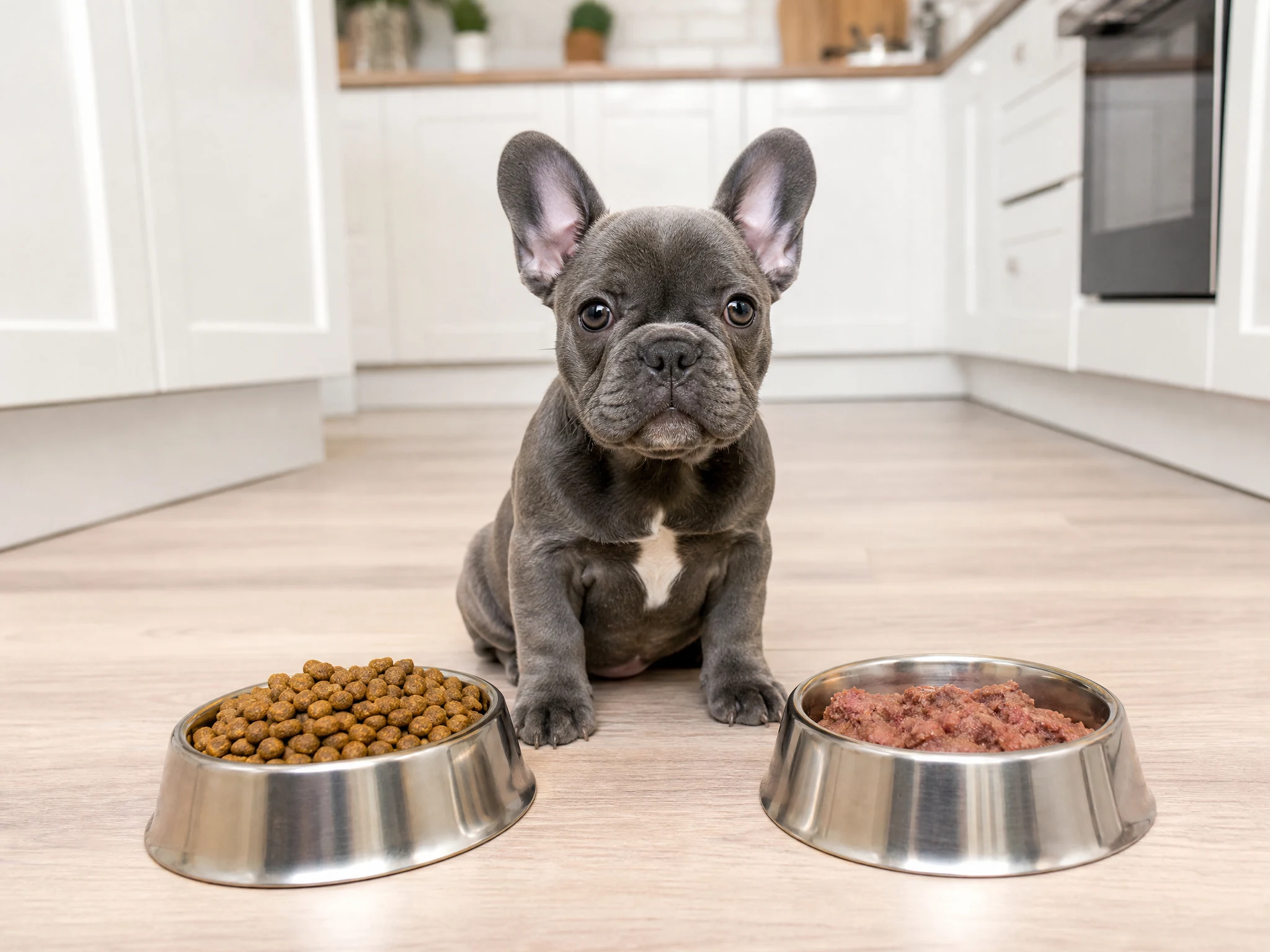
Start with the French Bulldog itself
The French Bull Dog Club of America breed standard says a French Bulldog should not exceed 28 pounds. Royal Canin's breed library lists males at 20 to 28 pounds and females at 17 to 24 pounds. Its life-stage table treats puppyhood as roughly 2 to 12 months.
That adult size shapes your food choice in two ways.
- No large-breed formula needed. The AAFCO large-size category covers dogs of 70 pounds or more as an adult. Whole Dog Journal explains that growth and all-life-stages labels now carry an "including" or "except for" statement about those big dogs. A French Bulldog is far below that cutoff, so an "except for growth of large-size dogs" label is not a problem for this breed.
- Calories matter. Royal Canin's breed library warns that French Bulldogs gain weight easily. A food that is dense in calories needs a smaller portion, so compare calories, not just protein.
For a side-by-side look at specific foods, see our label-by-label comparison of French Bulldog puppy foods.
What to look for on the label
1. The AAFCO nutritional adequacy statement
This is the first thing to find. It should say the food is complete and balanced for growth, or for all life stages. A food with only an "adult maintenance" statement is not a puppy food.
There are two ways a brand can back up the statement. Some foods are formulated to meet the AAFCO Dog Food Nutrient Profiles. Others say that animal feeding tests using AAFCO procedures substantiate the claim. Both are legitimate routes. Neither is a guarantee about how your puppy will do.
2. Guaranteed analysis
Look for minimum protein and fat, and maximum fiber. Be careful when comparing brands. Some list as-fed minimums. Others, like Hill's on the pages we reviewed, publish dry-matter averages instead. Those numbers measure different things and should not be set against each other directly.
3. Calories per cup
The label should state kilocalories per cup or per kilogram. This is how you compare portion sizes between foods. It is also how you keep a stocky, easy-gaining breed from creeping up in weight.
4. The first five ingredients
The ingredient list is ordered by weight before cooking. Read it for what it is, a description of the recipe. A named meat or meat meal near the top is fine. So is a by-product meal or a grain such as rice or wheat. None of these is automatically good or bad, and the list alone cannot tell you how a puppy will respond.
5. Kibble shape and size
Most brands do not publish a kibble size in numbers. Royal Canin says its French Bulldog puppy formula uses a curved kibble designed for the breed's short muzzle and underbite. That is the brand's design claim. Whether your puppy picks it up easily is something you can only see by watching them eat.
Key features to compare
The table below uses only data the brands publish on their own product pages. A blank or "not published" means we did not find the figure on the page.
| Food | Form | AAFCO statement | Protein / fat | Calories |
|---|---|---|---|---|
| Royal Canin Breed Health Nutrition French Bulldog Puppy | Dry | Growth, including large-size dogs | 28% min / 18% min | 373 kcal per cup |
| Victor Hi-Pro Plus Small & Medium Breed Puppy | Dry | All life stages, except growth of large-size dogs | 30% min / 18% min | 383 kcal per cup |
| Victor Hi-Pro Plus | Dry | All life stages, except growth of large-size dogs | 30% min / 20% min | 406 kcal per cup |
| Hill's Science Diet Puppy Chicken & Brown Rice | Dry | AAFCO feeding tests, growth | 28.1% / 19.1% (dry-matter averages) | 390 kcal per cup |
| Hill's Science Diet Puppy Small & Mini Chicken & Brown Rice | Dry | AAFCO feeding tests, growth and reproduction | 28.9% / 19.7% (dry-matter averages) | 418 kcal per cup |
| Freshpet Multi-Protein Puppy Recipe | Fresh | Growth | 16% min / 10% min | 241 kcal per cup |
| Freshpet Vital Puppy Chicken, Beef & Salmon | Fresh roll | All life stages, including large-size dogs | 10.5% min / 8% min | 1420 kcal per kg |
Fresh foods hold more water than dry kibble, so their percentages look lower. Do not read that as less nutrition. It is a moisture difference, and it is why as-fed percentages should only be compared within the same form.
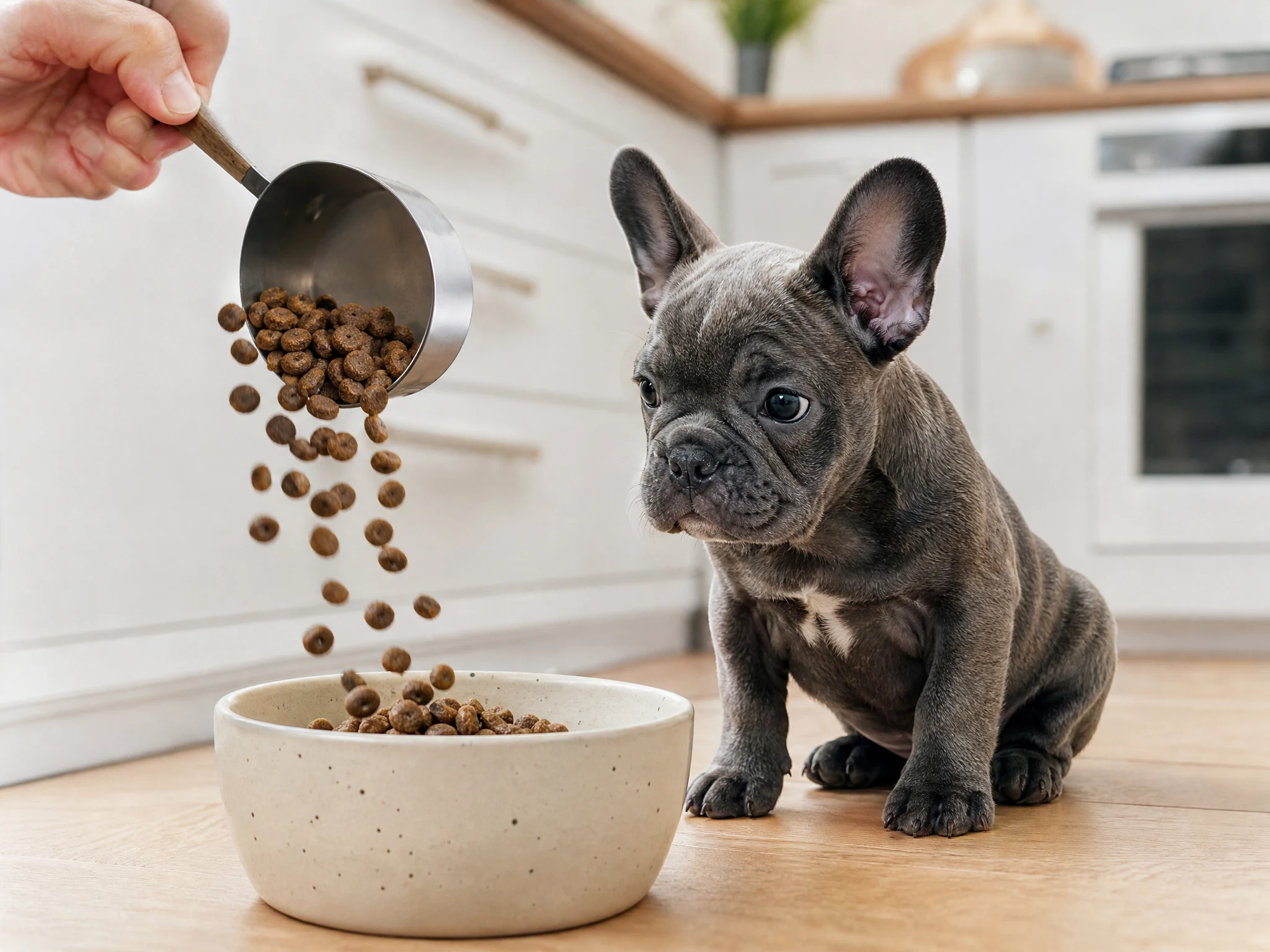
Label-based picks by type of food
The brand pages we reviewed do not publish prices, and prices change by store and bag size. We will not guess at them. Instead, these picks are grouped by the kind of food, so you can match one to your budget and routine after checking the brand's own page.
Breed-specific dry food
The Royal Canin French Bulldog Puppy dry food is the only product in our research made specifically for the breed. Its label lists 28% minimum protein, 18% minimum fat and 3.4% maximum fiber. It has 373 kcal per cup, the lowest of the dry foods in the table.
The first five ingredients are brewers rice, chicken by-product meal, wheat, chicken fat and chicken meal. The brand's feeding table runs by puppy age (2 to 9 months) and expected adult weight (18, 22 and 31 pounds). For example, it lists 1 1/2 cups (144 g) per day for a 3-month-old with an 18-pound target. Treat that as a starting point, not a final answer.
General small and medium puppy dry foods
The Victor Hi-Pro Plus Small & Medium Breed Puppy lists beef, chicken, beef meal, chicken meal and whole grain sorghum as its first five ingredients. Its guaranteed analysis shows 30% minimum protein and 18% minimum fat. The page's description also mentions a 26% protein figure, which does not match the guaranteed analysis, so rely on the analysis and ask the brand if you want clarity.
The Hill's Science Diet Puppy Chicken & Brown Rice is a regular puppy formula. Its page lists dry-matter averages of 28.1% protein, 19.1% fat and 1.54% calcium. Hill's also offers a Small & Mini puppy recipe, listed at 418 kcal per cup. Hill's says to adjust amounts to maintain optimal weight, which matters for this breed.
Wet and fresh options
Hill's makes canned puppy foods, such as the Puppy Chicken & Rice Stew. Its calories are listed per can (321 kcal per 12.5 oz can), not per cup, so portions need separate math.
Freshpet sells refrigerated puppy recipes, including the Multi-Protein Puppy Recipe at 241 kcal per cup. Its feeding guide is on the package. We did not find other Freshpet puppy recipes with full label data, so check the brand for the current range.
A note on foods for other breeds
Royal Canin also makes a Miniature Schnauzer puppy food. It is not a French Bulldog formula. A food designed for another breed's jaw and growth pattern is a size-based option at best, so do not choose it just because the numbers look similar.
Red flags to avoid
- No AAFCO statement. If you cannot find one, the food has not told you it is complete for growth.
- An adult-only statement. A puppy needs a growth or all-life-stages food.
- Health claims. A bag or ad that says it prevents, treats or cures allergies, joint trouble, heart disease or skin problems is making a medical claim. Food does not work that way, and only a veterinarian can say what diet suits your dog. Prescription diets come only from a veterinarian.
- Vague "premium" language. Words like "ancestral" or "human-grade" are marketing unless the label backs them up with data.
- Missing calorie information. Without kcal per cup, you cannot compare portions fairly.
- A recipe change every few weeks. Switching foods suddenly can upset a puppy's stomach. Royal Canin notes that many dogs with brachycephalic airway obstruction also show gastrointestinal signs, so go slowly and ask your veterinarian how to transition.
What about grain-free and DCM?
The FDA Center for Veterinary Medicine investigated a possible link between certain diets and canine dilated cardiomyopathy. Its last public update is dated 12/23/2022, and it says it will not publish more until there is meaningful new scientific information. That is a reason to ask your veterinarian, not a reason to panic or to pick a food on the strength of a slogan.
Health topics to raise with your veterinarian
French Bulldogs have breed-specific concerns, and they can affect how your puppy eats. The Royal Veterinary College lists breathing problems and skin fold dermatitis among the breed's predispositions. A UK VetCompass study, reported by Phys.org, found French Bulldogs had 11.18 times the odds of skin dermatitis compared with other breeds.
None of that means a particular food will prevent or fix these problems. If your puppy has itchy skin, loose stools or trouble eating, talk to a veterinarian before changing the diet.
Where to buy
We do not link to stores. Here is a safer routine.
- Open the brand's own product page and read the AAFCO statement, ingredients and feeding guide for the exact recipe.
- Compare that page with the bag in your hands. Recipes and bag sizes change, and the bag you hold is the final word.
- Buy from a seller you trust, such as a local pet supply shop or the brand's own site, and check the packaging date and condition.
- Ask your veterinarian before committing to a large bag. A puppy outgrows a feeding stage quickly.
Brand pages note that availability and sizes vary. If a recipe is not listed on the brand's page, check with the brand before assuming it exists.
Feeding amounts and portions
Every label's feeding guide is a starting point. Royal Canin's table is arranged by age and expected adult weight. Hill's says to adjust amounts as needed to maintain optimal weight. Victor's page says to follow the chart and, after age one, feed to maintain good body condition.
Weigh your puppy's portions with a measuring cup or scale, and check body condition regularly. Your veterinarian can tell you whether the amount suits your puppy's growth.
A short checklist
- Confirm a growth or all-life-stages AAFCO statement.
- Compare calories per cup before protein percentages.
- Check whether numbers are as-fed or dry-matter.
- Read the first five ingredients as a recipe description, not a verdict.
- Ignore any claim that a food treats or prevents a disease.
- Introduce changes slowly and ask your veterinarian.
Sources
- French Bull Dog Club of America, French Bulldog Breed Standard
- Royal Canin US breed library, French Bulldog
- Whole Dog Journal, In the Fine Print: Nutritional Adequacy Statements
- FDA Center for Veterinary Medicine, investigation into diets and canine dilated cardiomyopathy
- Royal Veterinary College, French Bulldogs: VetCompass reveals top health problems
- Phys.org report on the O'Neill et al. French Bulldog health study
- Royal Canin French Bulldog Puppy product page
- Hill's Science Diet Puppy product page
- Victor Hi-Pro Plus Small & Medium Breed Puppy product page
- Freshpet Multi-Protein Puppy Recipe product page