Best Food for a French Bulldog Puppy: A Label-by-Label Buying Guide

General nutrition information compiled from product labels and published sources, not veterinary advice. Your veterinarian is the right person to choose a diet for your dog, especially one with a health condition.
Picking the best food for french bulldog puppy life is mostly a reading exercise. Every bag and can carries the same few pieces of label data. Once you know which ones matter, the marketing on the front gets much easier to ignore.
This guide shows what to check on a puppy food label, how to compare formulas, and which warning signs to watch for. It uses published label data from the brands' own pages. We compared labels only. We did not run feeding trials or taste tests, and nothing here says one food is right for every puppy.
First, what makes a French Bulldog puppy different
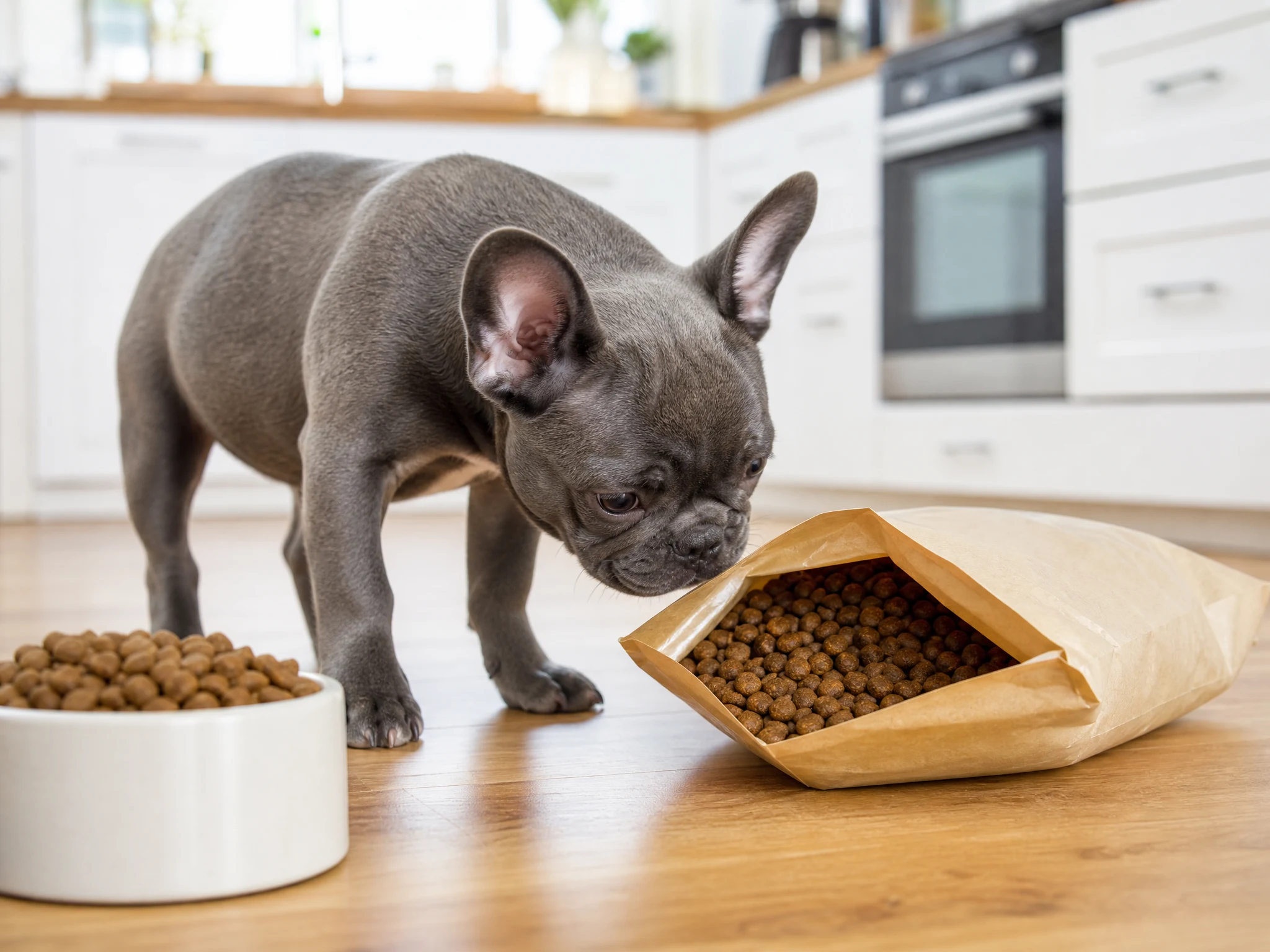
The French Bull Dog Club of America breed standard says a French Bulldog should not exceed 28 pounds. Royal Canin's breed library lists adult males at 20 to 28 pounds and females at 17 to 24 pounds. Royal Canin's life-stage table treats the puppy stage as roughly 2 to 12 months.
That small adult size matters when you read labels. AAFCO's large-size category covers dogs that reach 70 pounds or more as adults. Whole Dog Journal explains that growth and all-life-stages labels must now say either "including" or "except for" growth of large-size dogs. A French Bulldog puppy is well under that line. An "except for growth of large-size dogs" statement is therefore not a red flag for this breed.
Royal Canin also notes that the breed gains weight easily, and it links the flat-faced build to breathing and digestive issues. Your veterinarian decides what suits an individual puppy. What a label can do is give you honest numbers to compare.
What to look for: quality indicators on the label
1. The AAFCO nutritional adequacy statement
This is the most important line on the package. For a puppy, look for wording that says the food meets the AAFCO Dog Food Nutrient Profiles for growth, or for all life stages. A statement like "for maintenance" or "adult" is the wrong one for a growing puppy.
There are two ways a food can back up that claim. Some are formulated to meet the profiles. Others add animal feeding tests using AAFCO procedures. Hill's Science Diet puppy pages, for example, cite feeding tests. Royal Canin and Victor cite formulation to meet the nutrient profiles. Both routes are recognized, but they are different, so note which one you are looking at.
2. The first five ingredients
Ingredients are listed by weight before cooking, so the first few tell you the most. Check what the main protein and carbohydrate sources are. Be aware that fresh meat contains a lot of water, while a "meal" is a concentrated, dried form. A list that opens with chicken is not automatically better or worse than one that opens with a meal. It is simply different.
3. Guaranteed analysis
The guaranteed analysis lists minimum protein and fat and maximum fiber. Some brands publish more, such as calcium. Not every brand does. If a number is missing from the brand's page, ask the brand rather than guessing.
4. Calories per cup
Calories matter for a breed that gains weight easily. Two foods can look alike in the ingredient list and still differ by 40 or more kcal per cup. Use the brand's own feeding guide as a starting point and adjust with your veterinarian as your puppy grows.
5. Kibble shape and size
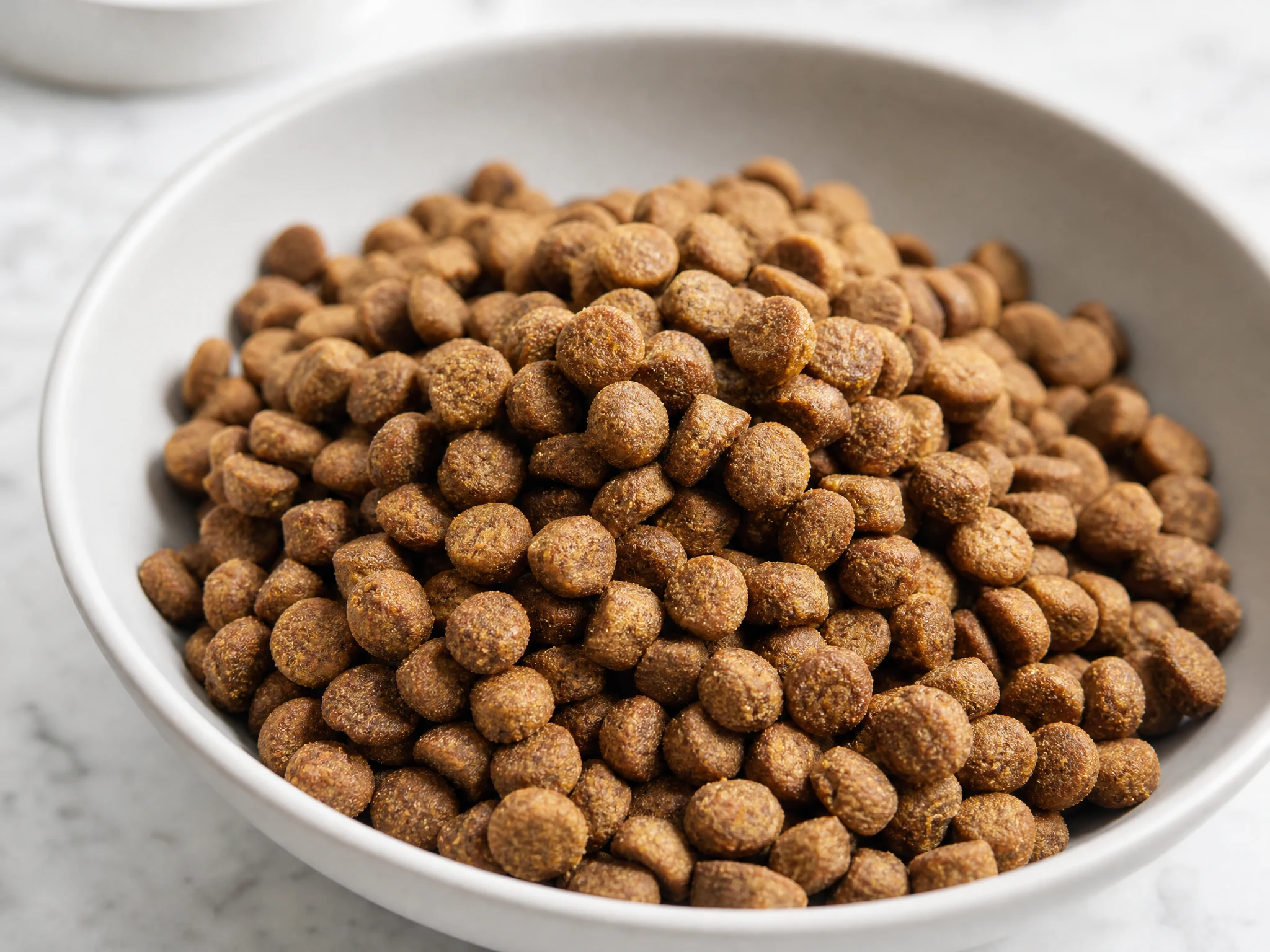
Royal Canin describes its French Bulldog puppy kibble as curved, designed for a short muzzle and underbite. That is the brand's description, and we have not fed it to a puppy. Most other brands in this guide do not publish a numeric kibble size, so a number is something to ask the brand for.
Key features to compare side by side
The table below lists label data from each brand's own product page. Read it with one caution. The Hill's figures are dry-matter averages, not guaranteed minimums, and the Freshpet figure is for a moist fresh food. Dry-matter and as-fed numbers should not be compared directly across foods. We left blanks where the brand page did not publish the figure.
| Food | Form | AAFCO statement | Protein | Fat | Calories |
|---|---|---|---|---|---|
| Royal Canin Breed Health Nutrition French Bulldog Puppy | Dry | Growth, including large-size dogs | 28% min | 18% min | 373 kcal/cup |
| Hill's Science Diet Puppy Chicken & Brown Rice | Dry | Feeding tests, growth | 28.1% dry-matter average | 19.1% dry-matter average | 390 kcal/cup |
| Hill's Science Diet Puppy Small & Mini Chicken & Brown Rice | Dry | Feeding tests, growth | 28.9% dry-matter average | 19.7% dry-matter average | 418 kcal/cup |
| Victor Hi-Pro Plus Small & Medium Breed Puppy | Dry | All life stages, except large-size growth | 30% min | 18% min | 383 kcal/cup |
| Victor Hi-Pro Plus | Dry | All life stages, except large-size growth | 30% min | 20% min | 406 kcal/cup |
| Freshpet Multi-Protein Puppy Recipe | Fresh | Growth | 16% min | 10% min | 241 kcal/cup |
Fiber maximums, where published, were 3.4% for the Royal Canin formula, 5.0% for Victor Small & Medium Breed Puppy, 3.8% for Victor Hi-Pro Plus and 2% for the Freshpet recipe. Hill's lists calcium averages of 1.54% on the original puppy recipe and 1.58% on the small and mini recipe. The other brands did not publish calcium on the pages we compared, so check with the brand if calcium matters to you.
For a longer side-by-side, see our label-by-label comparison of puppy foods for French Bulldogs.
Top picks by type of food
We are not listing prices. Prices change often and vary by store and bag size, and we have no verified figures to share. Instead, here are the options grouped by what kind of food they are. Check the current cost on the brand's own page.
A breed-specific dry formula
The Royal Canin French Bulldog Puppy dry food is the only product in this guide made for the breed. Its first five ingredients are brewers rice, chicken by-product meal, wheat, chicken fat and chicken meal. The label shows 28% protein minimum, 18% fat minimum and 373 kcal per cup. Its feeding guide uses puppy age from 2 to 9 months and a target adult weight of 18, 22 or 31 pounds. For example, a 3-month-old with an 18-pound target starts at 1 1/2 cups (144 g) a day, as a starting point only.
A dry formula backed by feeding tests
Hill's Science Diet Puppy Chicken & Brown Rice lists chicken, brown rice, whole grain wheat, chicken meal and chicken fat first. It is a regular puppy formula, not a breed formula. The Puppy Small & Mini version has more calories per cup at 418, which is worth noting for a breed that gains weight easily. Hill's does not publish kibble size on these pages.
A higher-protein, "except large-size" dry formula
Victor's Hi-Pro Plus Small & Medium Breed Puppy lists beef, chicken, beef meal, chicken meal and whole grain sorghum first. It has a guaranteed 30% protein minimum and 18% fat minimum. Its statement excludes large-size growth, which suits a French Bulldog. One oddity: the page text mentions 26% protein in one sentence while the guaranteed analysis says 30%. We used the guaranteed analysis. If the difference matters to you, ask Victor which figure applies.
The Victor Hi-Pro Plus is not breed or size specific. It is the most calorie-dense dry food in the table at 406 kcal per cup. Its feeding note suggests offering as much as the puppy will eat in 20 minutes across four meals. For a breed that gains weight easily, ask your veterinarian whether that approach suits your puppy.
A fresh food option
Freshpet's Multi-Protein Puppy Recipe lists chicken, eggs, beef, beef liver and green beans first, at 241 kcal per cup. Fresh food is moist, so its protein and fat percentages look low next to dry food. That is a water-content effect, not proof of lower quality. Its AAFCO statement on the page covers growth. Freshpet also makes a Vital Puppy recipe, stated for all life stages including large-size growth, at 1420 kcal per kilogram.
Wet foods from Hill's
Hill's also makes canned puppy foods, such as the Puppy Chicken & Rice Stew, which is 321 kcal per 12.5 oz can. Its calories are listed per can, not per cup, so you cannot line it up with the dry foods without doing the math by weight.
Red flags to avoid
- No AAFCO statement, or the wrong one. A puppy needs growth or all-life-stages. "Maintenance" or "adult" is not it.
- Claims that a food prevents or treats a disease. No food label should promise to fix skin, joints, allergies or heart disease. Skin fold and ear problems are common in the breed according to the Royal Veterinary College and a UK VetCompass report, but diet decisions for a puppy with these issues belong with your veterinarian.
- Missing numbers. If a brand will not state protein, fat or calories, that is a reason to look elsewhere or ask.
- Calories you cannot find. You need this figure to avoid overfeeding.
- Front-of-bag buzzwords. Terms like "premium" or "natural" are not substitutes for the statement and analysis on the back.
- Sensitive-stomach or skin wording treated as a medical claim. Such formulas are marketed foods, not prescription diets. Prescription diets are something only a veterinarian prescribes.
- Large-breed puppy formulas chosen out of caution. They are designed for dogs expected to reach 70 pounds or more. The breed standard caps a French Bulldog at 28 pounds.
A note on grain-free and DCM
You may see grain-free foods described in worried terms. The FDA investigated a potential link between certain diets and canine dilated cardiomyopathy. Its last public update is dated December 23, 2022, and the agency said it would not publish more until there is meaningful new scientific information. We cannot settle that question for you. If you are weighing a grain-free recipe, ask your veterinarian and read the FDA page.
Where to buy
Start with the brand's own product page. It shows the current label, the AAFCO statement and the feeding guide, which is the information you need before you buy. Many brands also offer a way to find stockists on their site, and some sell direct. Check each brand's page for current options.
Your veterinarian is also a good source for puppy food and can tell you what is stocked locally. Whatever you choose, compare the label on the bag in your hands with the brand page, since formulas can change.
When you switch foods, ask your veterinarian how to transition gradually. Also treat every feeding chart as a starting point. Watch your puppy's body condition and adjust with professional guidance.
A simple buying checklist
- Confirm the AAFCO statement says growth or all life stages.
- Read the first five ingredients and note the main protein.
- Write down protein, fat, fiber and calories per cup, noting whether numbers are minimums or dry-matter averages.
- Check whether the statement says "including" or "except for" large-size growth. Either is workable for this breed.
- Ask the brand for anything missing, such as calcium or kibble size.
- Bring your shortlist to your veterinarian before committing to a large bag.
Sources
- French Bull Dog Club of America, French Bulldog Breed Standard
- Royal Canin US breed library, French Bulldog
- Whole Dog Journal, In the Fine Print: Nutritional Adequacy Statements
- FDA Center for Veterinary Medicine, investigation into diets and canine dilated cardiomyopathy
- Royal Veterinary College, French Bulldogs: VetCompass reveals top health problems
- Royal Canin US, French Bulldog Puppy product page
- Hill's Pet, Science Diet Puppy product pages
- Victor Pet Food, Hi-Pro Plus product pages
- Freshpet, puppy product pages