Best Dog Food for French Bulldog Puppies: A Buying Checklist

General nutrition information compiled from product labels and published sources, not veterinary advice. Your veterinarian is the right person to choose a diet for your dog, especially one with a health condition.
Finding the best dog food for French Bulldog puppies is mostly a job of reading labels with a skeptical eye. Front-of-bag claims are marketing. The back of the bag holds the information you can check.
This guide gives you a checklist to run on any puppy food. It then shows how a handful of real products look when you apply it. We compared label data only. We did not run feeding trials or taste tests, and we are not saying any food will prevent or treat a health problem.

Start with the breed, not the bag
The French Bull Dog Club of America breed standard says a French Bulldog should not exceed 28 pounds. Royal Canin's breed library lists adult males at 20 to 28 lb and females at 17 to 24 lb. Royal Canin's life-stage table treats the puppy stage as 2 to 12 months.
That adult size matters for one label phrase. AAFCO growth and all-life-stages labels must say either "including growth of large-size dogs" or "except for growth of large-size dogs," and "large-size" means 70 pounds or more as an adult. This is according to Whole Dog Journal, a secondary source. A French Bulldog is far below that line, so an "except for growth of large-size dogs" statement is not a problem for this breed.
The breed also comes with a few things worth knowing before you shop. Royal Canin notes the breed gains weight easily. It also says many dogs with brachycephalic airway obstruction syndrome show gastrointestinal signs. The Royal Veterinary College lists skin fold dermatitis among the breed's predispositions. None of this means a particular food solves anything. It means calorie control and a vet's guidance matter, and it is why the checklist below pays attention to kcal and feeding guides.
The checklist: what to look for
1. A complete and balanced statement for growth
Find the AAFCO nutritional adequacy statement. For a puppy you want one of these:
- "Formulated to meet" the AAFCO Dog Food Nutrient Profiles for growth.
- "Formulated to meet" the profiles for all life stages.
- "Animal feeding tests using AAFCO procedures" substantiate complete and balanced nutrition for growing puppies.
A food with only an adult maintenance statement is not a puppy food, whatever the bag photo shows. If the statement is missing or vague, treat that as a reason to move on.
2. The large-size wording
Check which of the two large-size phrases appears. For a French Bulldog, either one is acceptable. The "including" wording simply signals the food meets the lower calcium limits set for large dogs, per Whole Dog Journal. You do not need it for this breed, but it does not hurt either.
3. The first five ingredients
Ingredients are listed by weight before cooking. Look for named sources such as chicken, beef, salmon or chicken meal. A "meal" is a concentrated ingredient with the water removed, so it is not automatically worse than a fresh meat. Fresh meat contains a lot of water, which is why it can lead a list and still contribute less dry protein than it seems.
Also notice whether the list starts with a grain or a meat. Neither is a verdict on its own. The point is to know what you are buying.
4. Guaranteed analysis
The guaranteed analysis gives minimum protein and fat and maximum fiber and moisture. Compare foods of the same form only. A canned or fresh food has a lot of water, so its percentages look small next to dry kibble even when the recipe is comparable. Some brands, including Hill's, publish dry-matter averages on their pages instead of minimums and maximums. Those numbers are not directly comparable to a guaranteed analysis.
5. Calories per cup
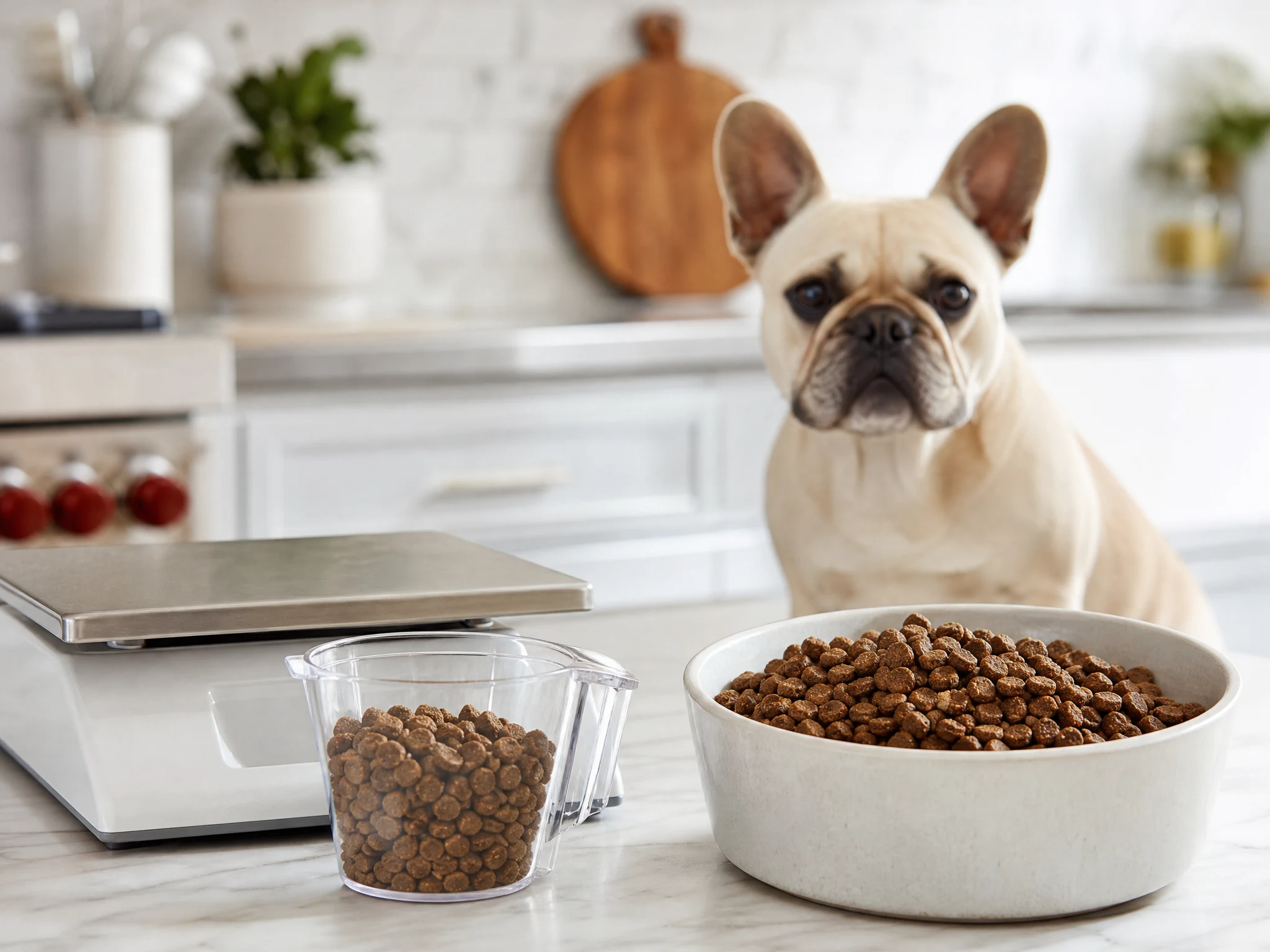
For a breed that gains weight easily, kcal per cup is one of the most useful numbers on the label. Two foods can look alike but differ by 40 or more kcal per cup, which changes how much a measured portion adds up to over a day. Weigh or measure every meal, and treat the feeding chart as a starting point.
6. Kibble shape and size
Royal Canin says its French Bulldog puppy kibble is curved and "specially designed for your French Bulldog's short muzzle and underbite." Most other brands do not publish a numeric kibble size on the pages we compared, so ask the brand. We did not test how any kibble works for a flat-faced puppy, so watch your own puppy at mealtime and talk to your veterinarian if eating looks difficult.
7. A feeding guide you can follow
A good label gives a table by age and expected adult weight. Royal Canin's French Bulldog puppy page, for example, gives daily amounts by age (2 to 9 months) for target adult weights of 18, 22 and 31 lb. At 3 months and an 18 lb target, the guide lists 1 1/2 cups (144 g) per day. Use numbers like these as a starting point and adjust with your veterinarian based on your puppy's body condition.
Label comparison of real puppy foods
The table below uses data from each brand's own product page. A blank-looking "not published" means the page did not give a number, so check with the brand. For a longer side-by-side, see our French Bulldog puppy foods compared label by label.
| Food | Form | AAFCO statement | Protein / fat | Calories |
|---|---|---|---|---|
| Royal Canin Breed Health Nutrition French Bulldog Puppy | Dry | Growth, including large-size dogs | 28% min / 18% min | 373 kcal per cup |
| Hill's Science Diet Puppy Chicken & Brown Rice | Dry | Feeding tests, growth | 28.1% / 19.1% (dry-matter averages) | 390 kcal per cup |
| Hill's Science Diet Puppy Small & Mini Chicken & Brown Rice | Dry | Feeding tests, growth | 28.9% / 19.7% (dry-matter averages) | 418 kcal per cup |
| Victor Hi-Pro Plus Small & Medium Breed Puppy | Dry | All life stages, except large-size growth | 30% min / 18% min | 383 kcal per cup |
| Victor Hi-Pro Plus | Dry | All life stages, except large-size growth | 30% min / 20% min | 406 kcal per cup |
| Freshpet Multi-Protein Puppy Recipe | Fresh | Growth | 16% min / 10% min | 241 kcal per cup |
| Freshpet Vital Puppy Chicken, Beef & Salmon | Fresh roll | All life stages, including large-size growth | 10.5% min / 8% min | 1420 kcal/kg; 322 kcal per 1/2 lb |
Two cautions on reading this. Fresh foods hold much more water, so their lower percentages are not a sign of a weaker recipe. And Victor's page describes a protein-to-fat ratio of 26% and 18% in its description while the guaranteed analysis says 30% minimum protein. When a page contradicts itself, go by the guaranteed analysis and ask the brand to clarify.
Top picks by type
None of the brand pages we compared gave a price, so we cannot rank foods by cost. Price per day depends on your region, the bag size and how much your puppy eats. Check the brand's own page and compare cost per day using the feeding guide and kcal per cup, rather than cost per bag.
Instead, here are label-based notes by type of food.
A breed-specific dry food
Royal Canin Breed Health Nutrition French Bulldog Puppy is the only food in this group made for the breed. Its label lists brewers rice, chicken by-product meal, wheat, chicken fat and chicken meal as the first five ingredients. It is not grain-free. It has the lowest kcal per cup of the dry foods in our table, at 373, and it gives a feeding table specific to small adult weights. By-product meal in the first spots may put some owners off, so decide whether that fits your preferences.
Dry foods with feeding-test statements
Hill's Science Diet uses the feeding-test form of the AAFCO statement. See the Puppy Chicken & Brown Rice page and the Small & Mini page. Both lead with chicken and list chicken meal and chicken fat in the top five. Their pages give dry-matter averages instead of guaranteed minimums. The small and mini version is the more calorie-dense at 418 kcal per cup versus 390, so measure carefully. Hill's pages do not state a kibble size.
Higher-protein dry foods
Victor's Hi-Pro Plus Small & Medium Breed Puppy lists 30% minimum protein and 18% minimum fat with 383 kcal per cup. Its fiber maximum is 5.0%, higher than the others in the table. The standard Hi-Pro Plus has 20% minimum fat and 406 kcal per cup, and its page suggests feeding as much as the puppy will eat in 20 minutes, four times a day. For a breed that gains weight easily, that style of free-choice guidance is worth discussing with your veterinarian before you follow it.
Fresh foods
Freshpet's Multi-Protein Puppy Recipe lists chicken, eggs, beef, beef liver and green beans first, at 241 kcal per cup. Its Vital Puppy roll is labeled for all life stages including large-size growth. Fresh foods need the storage and serving steps on the package, so read those before buying. Check the brand for ingredients beyond the first five and for grain information.
Wet foods
Hill's also makes puppy canned foods, such as the Puppy Chicken & Rice Stew. Its calories are given per can (321 kcal per 12.5 oz can), not per cup, so you cannot compare it to kibble by volume. Use it with the can's feeding guidance and count it toward the day's total.
Red flags to avoid
- No AAFCO statement, or an adult-only statement on a food sold for puppies.
- Vague ingredients such as "meat" or "animal fat" with no named source.
- Health claims on the bag. A food cannot be promised to prevent or treat hip problems, allergies, heart disease or bloat. Prescription diets are something only a veterinarian prescribes.
- Calories not listed. Without kcal per cup, portion control is guesswork.
- A feeding chart with no adjustment advice. Good labels tell you to adjust to body condition.
- Contradictory page data. If the description and guaranteed analysis disagree, ask the brand which is correct.
- Fear-based marketing. Be wary of any page that tells you other foods are dangerous.
A note on DCM headlines
You may see grain-free diets discussed alongside canine dilated cardiomyopathy. The FDA's Center for Veterinary Medicine has an investigation page, and its latest update is dated 12/23/2022. The FDA says it will not publish further public updates until there is meaningful new scientific information. We are not saying any food here causes or avoids the condition. If this concerns you, ask your veterinarian which diet suits your individual puppy.
Where to buy
Start with the brand's own product page, which lists the current formula, the AAFCO statement and the feeding guide. Compare the bag you hold in your hands with that page, since formulas and package text can change.
Beyond that, check whether the brand offers a store finder or direct ordering, and ask your veterinarian's office or a local pet supply shop whether they stock the food. We do not link to retailers, and we cannot tell you which stores carry which foods or what they charge. Check the brand directly for that.
When you change foods, do it gradually and follow the brand's guidance and your veterinarian's advice. Keep a note of the product name, lot and the date you started, in case you need to talk to the brand or your vet.
Quick checklist to print
- Confirm a growth or all-life-stages AAFCO statement.
- Accept either large-size phrase, since the breed tops out around 28 lb.
- Read the first five ingredients for named sources.
- Compare guaranteed analysis within the same food form.
- Write down kcal per cup and measure every meal.
- Ask the brand about kibble size and shape if it is not stated.
- Check the brand page for current label data and price.
- Review the choice with your veterinarian, who decides for your individual puppy.
Sources
- French Bull Dog Club of America, French Bulldog Breed Standard
- Royal Canin US breed library, French Bulldog
- Royal Veterinary College, French Bulldogs: VetCompass reveals top health problems
- Whole Dog Journal, In the Fine Print: Nutritional Adequacy Statements
- FDA Center for Veterinary Medicine, DCM investigation
- Royal Canin French Bulldog Puppy product page
- Hill's Pet product pages
- Victor Pet Food product pages
- Freshpet product pages